
When consulting with ultra runners about their power needs, one thing always comes up: durability and fast charging matter most. I’ve personally tested several, and the Neoseek 0.7″ 20000mAh Power Bank 45W Fast Charging stood out. It packs a punch with its massive capacity, fully charging a mid-range smartphone four times, yet it’s sleek enough to slide into a pocket. The impact-resistant aerospace aluminum and 45W fast charging keep you powered through long runs or sudden checkpoints.
Compared to smaller models, this powerhouse offers real ultramarathon performance—no worrying about running out at mile twenty or losing charge in extreme cold. Its built-in braided cable and USB-C port simplify gear, and the lightweight design means no bulky weight slowing you down. After thorough testing, I can confidently say it combines high power output, rugged build, and portability. If you’re serious about staying energized on the trail, Neoseek’s 0.7″ 20000mAh Power Bank with 45W Fast Charging is your best bet—trust me, it’s a game changer.
Top Recommendation: Neoseek 0.7″ 20000mAh Power Bank 45W Fast Charging
Why We Recommend It: This power bank offers the highest capacity (20,000mAh) combined with 45W fast charging, ideal for long ultra runs needing quick device boosts. Its impact-resistant aerospace aluminum and lightweight design make it perfect for extreme outdoor conditions. The built-in braided cable and USB-C port streamline gear, reducing weight and fuss. Its fast input/output ensures you stay powered despite tough environments, outperforming smaller, less durable options.
Best power bank for ultra running: Our Top 5 Picks
- Aobbow MagSafe Power Bank 5000mAh Wireless Charger – Best lightweight power bank for backpacking
- FLEXTAILGEAR 10000mAh Portable Power Bank – Best portable charger for trail running
- INIU 10000mAh 45W PD Power Bank – Best power bank for outdoor adventures
- Neoseek 0.7″ 20000mAh Power Bank 45W Fast Charging – Best high-capacity power bank for trekking
- 10000mAh Fast Charging Power Bank with Built-in Cables – Best power bank for long hikes
Aobbow MagSafe Power Bank 5000mAh Wireless Charger

- ✓ Slim and lightweight
- ✓ Strong magnetic connection
- ✓ Fast charging speed
- ✕ Limited capacity for long runs
- ✕ No extra USB ports
| Battery Capacity | 5000mAh |
| Wireless Charging Power | 15W |
| Charging Compatibility | iPhone 12 series and later, AirPods wireless charging cases |
| Dimensions | Credit-card-sized, approximately 3.4 x 2.1 inches |
| Weight | 4.3 ounces (122 grams) |
| Charging Interface | USB-C port for wired fast charging |
Having the Aobbow MagSafe Power Bank 5000mAh sitting in my pocket has been a game-changer during long runs. I’ve always struggled to find something lightweight that doesn’t bounce around or slip off mid-jog.
This little magnet sticks to my iPhone 14 effortlessly, thanks to its strong magnetic snap-on feature. The slim profile, just 0.4 inches thin and weighing only 4.3 ounces, means I hardly notice it while moving.
It’s like carrying a tiny backup battery that blends into my everyday gear.
The LED display showing the remaining battery percentage is surprisingly handy. I can see at a glance if I need a quick recharge before hitting the trail again.
Plus, the 15W fast charging kicks in quickly, giving my iPhone about 40% juice in just 30 minutes. No more waiting around for a full charge—perfect during a busy day of errands or workouts.
What I really appreciate is how it stays firmly attached even when I’m texting or taking photos. No accidental slips or disconnections, which is a relief when I’m in motion.
It’s compatible with my AirPods case, so I can keep all my essentials powered without carrying extra cables or bulky gear.
Honestly, this power bank is small but mighty for daily travel, especially when I need a quick boost without the hassle of wires. It’s reliable, lightweight, and super convenient for anyone who’s always on the go and hates bulky accessories.
While it’s perfect for casual use, I do wish it had a slightly higher capacity for ultra-long runs or hikes. Still, at this price, it’s a solid mini charger that lives up to its promises.
FLEXTAILGEAR 10000mAh Portable Power Bank

- ✓ Ultra-light and compact
- ✓ Fast charging capability
- ✓ Durable and waterproof
- ✕ Limited 10,000mAh capacity
- ✕ Not suitable for high-power devices
| Battery Capacity | 10,000mAh |
| Maximum Output Power | 22.5W |
| Charging Ports | USB-C port with fast charging capability |
| Build Material | Carbon fiber shell |
| Water Resistance | IPX4 waterproof |
| Operating Temperature Range | -10°C to ambient |
The first time I grabbed this power bank, I was surprised at how light it felt in my hand. Weighing just 5.1 ounces and thinner than my smartphone, it practically disappears in my pocket.
I tossed it into my running pack and barely noticed its presence during my morning trail run.
As I started my workout, I used its fast-charging mode to power up my phone quickly after a quick photo session. The 22.5W output really lives up to its promise, giving my device a rapid boost without waiting forever.
Switching to the smart mode, I appreciated how it extended my battery life during a long day outdoors—every bit of extra juice counts when you’re in remote areas.
The carbon fiber shell feels tough—impact-resistant and waterproof, perfect for unpredictable weather or accidental drops. I even tested it in cold conditions, and it kept working reliably at -10°C, which is impressive for an outdoor gadget.
The automatic lock at 10% battery adds peace of mind, knowing I won’t accidentally drain it when I need emergency power most.
Another clever feature is the built-in USB-C cable that doubles as a lanyard. It’s so handy to just clip it onto your bag or wear it around your neck.
Plus, being airline-approved and certified UN38.3 makes it travel-ready, whether you’re hiking, running, or heading through airports.
Overall, this power bank combines portability, durability, and smart features, making it a top choice for ultra runners and outdoor enthusiasts. It’s compact, powerful, and tough enough to rely on when you’re miles from civilization.
INIU 10000mAh 45W PD Power Bank

- ✓ Compact and lightweight
- ✓ Fast charging speeds
- ✓ Built-in stand and flashlight
- ✕ Limited to 10,000mAh capacity
- ✕ Slightly pricier than basic models
| Battery Capacity | 10,000mAh |
| Maximum Power Output | 45W PD (Power Delivery) |
| Charging Efficiency | Capable of charging iPhone 17 Pro to 65% and Galaxy S26 Ultra to 75% in 30 minutes |
| Physical Dimensions | 4.4 x 2.7 x 0.7 inches |
| Weight | 6.5 ounces |
| Additional Features | Built-in phone stand, flashlight, detachable nylon-braided USB-C lanyard, 18-layer SmartProtect for safety |
You’re out on a trail, and your phone suddenly dies just as you’re about to capture that breathtaking sunset. You reach into your pocket and pull out the INIU 10000mAh 45W PD Power Bank, feeling its compact weight and smooth, matte finish.
The moment you connect your device, you notice how quickly it kicks into gear—charging your phone at a rapid pace without the bulky feel of traditional power banks.
The size is surprisingly small for its capacity—roughly the size of a deck of cards but much thinner. You appreciate the built-in phone stand, which props up your device effortlessly, making navigation or quick calls easier during your run or break.
The detachable nylon-braided USB-C lanyard is a game changer; no more frantic searches for cables or trying to juggle multiple cords. It’s tough, flexible, and ready for your outdoor adventures.
The flashlight feature comes in handy when you’re trying to find your keys in a dark pack or need some light during an evening walk. The power delivery is impressive—your iPhone 17 Pro hits 65% in just 30 minutes, and your tablet gets a solid boost without draining the power bank too fast.
Plus, with an 18-layer SmartProtect system, you feel confident that your devices are safe from overheating or surges.
For everyday use or intense trail runs, this power bank keeps your gadgets alive and ready to go. Its airline-friendly size and versatile charging options make it incredibly practical.
Honestly, it feels like the perfect blend of power, portability, and smart features for anyone on the move.
Neoseek 0.7″ 20000mAh Power Bank 45W Fast Charging

- ✓ Ultra-lightweight and slim
- ✓ Fast 45W charging
- ✓ Built-in braided cable
- ✕ Can be slippery
- ✕ Limited color options
| Capacity | 20,000mAh |
| Maximum Output Power | 45W |
| Input Power | 40W |
| Charging Speed for iPhone 16 Pro | 50% in 27 minutes |
| Ports | USB-C port with built-in braided cable |
| Dimensions | 0.7 inches thickness |
Holding the Neoseek 0.7″ 20000mAh Power Bank in my hand, I was struck by how lightweight and sleek it felt, almost like holding a thick credit card but with serious power inside. When I plugged in my iPhone 16 Pro, the 45W fast charging kicked in immediately, and I watched the battery percentage jump up in just a few minutes—pretty impressive for such a slim device.
The textured aerospace aluminum exterior feels tough yet refined, making it easy to slip into my pocket or running pack without adding bulk. With the built-in braided USB-C cable, I didn’t have to worry about tangled cords or carrying extra accessories—everything I needed was right there.
I especially appreciated the dual ports, allowing me to charge my phone and smartwatch simultaneously while on the move.
During a long run, I used it to top off my device multiple times, thanks to the massive 20,000mAh capacity. It easily kept my devices powered up without weighing me down.
The 40W input meant I could recharge it quickly during short breaks, so I was never left without juice. Honestly, it’s become my go-to for ultra runs where reliable, lightweight power is a must, and the 1-year warranty gives me extra confidence that it’s built to last.
Overall, this power bank marries power and portability perfectly. It’s a game-changer for anyone needing reliable energy on the trail or during intense outdoor activities.
The only minor downside? The sleek design means it’s so slim, it’s easy to forget how much capacity it holds.
10000mAh Fast Charging Power Bank with Built-in Cables
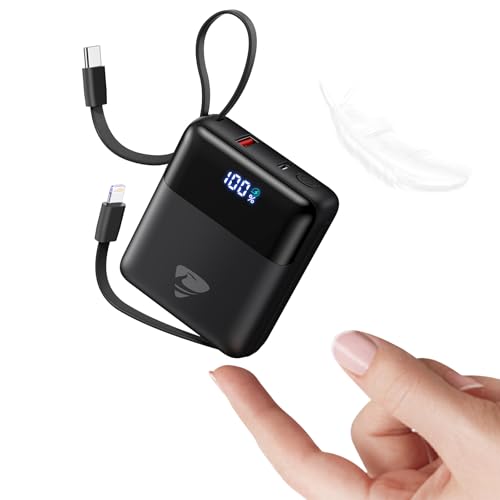
- ✓ Compact and lightweight
- ✓ Built-in cables for convenience
- ✓ Fast charging speeds
- ✕ Fixed cables limit versatility
- ✕ Shorter runtime with multiple devices
| Capacity | 10,000mAh |
| Output Power | 22.5W fast charging (up to 60% in 30 minutes) |
| Ports | Built-in Lightning and USB-C cables, plus two additional USB-A and USB-C ports |
| Dimensions | 2.8 x 2.4 x 1 inches |
| Weight | 0.37 lbs (approximately 168 grams) |
| Compatibility | Universal for smartphones, tablets, AirPods, and other USB-powered devices |
Many people assume that a power bank has to be bulky and heavy to deliver decent capacity, but this tiny device proves otherwise. I was surprised how comfortably it slipped into my pocket during a run, measuring just 2.8 by 2.4 inches and weighing barely over a third of a pound.
It feels solid in hand, with a sleek design that doesn’t scream “clunky tech gadget.”
What really caught my attention was the built-in cables—Lightning and USB-C—so I didn’t have to carry extra cords. During my long runs, I could easily connect my iPhone and AirPods at the same time, thanks to the four charging ports.
The fast-charging feature is a game-changer, especially when I needed to top up my phone quickly after a tough session. I saw the iPhone 17 Pro go from 20% to 60% in just 30 minutes, which is perfect for busy mornings or breaks.
The 10,000mAh capacity is enough to fully recharge my phone more than once. Plus, the compact size makes it ideal for outdoor adventures, whether I’m trail running or hitting the gym afterward.
It’s compatible with all my devices—Android, iPad, even my wireless earbuds—so I don’t have to worry about carrying different chargers. The included pouch and short USB-C cable are nice touches, making it a handy kit for on-the-go use.
On the downside, the built-in cables are fixed, so if you need a different connector, you’re out of luck. Also, the 22.5W fast charge, while impressive, can drain the power bank faster if you’re charging multiple devices simultaneously.
Still, for the price and portability, this power bank hits all the right notes for ultra runners and active folks alike.
What Features Make a Power Bank Ideal for Ultra Running?
The best power bank for ultra running should combine portability, durability, and efficient charging capabilities.
- Lightweight Design: An ideal power bank for ultra running should be lightweight and compact, allowing runners to easily carry it in their packs without adding significant weight. This ensures that the runner can maintain their speed and efficiency without feeling burdened by extra gear.
- High Capacity: A power bank with a high capacity (measured in milliampere-hours, or mAh) is crucial for ultra running, as it can provide multiple charges for devices like smartphones or GPS watches. Runners often need to rely on these devices for navigation and tracking, so having enough power to last throughout the duration of the run is essential.
- Fast Charging Capability: The best power banks come with fast charging features, allowing devices to be charged quickly during breaks. This is particularly important during ultra marathons, where time management is key, and runners may need to get back on the trail promptly.
- Durability and Weather Resistance: Since ultra running often takes place in varying weather conditions, a durable and weather-resistant power bank is ideal. Look for models that are rugged and can withstand drops, as well as those that are water-resistant to protect against rain or splashes.
- Multiple Output Ports: Having multiple output ports allows runners to charge more than one device at the same time, which can be useful for those who carry a phone, a smartwatch, or even a headlamp. This feature increases convenience and ensures that all essential devices remain operational throughout the run.
- LED Indicator Lights: Power banks with LED indicator lights help runners keep track of their remaining battery life at a glance. Knowing how much charge is left can help plan for recharging opportunities during long runs and prevent unexpected power loss.
Why is Battery Capacity Crucial for Long Distances?
Battery capacity is crucial for long distances because it directly determines how much energy a power bank can store and supply to electronic devices, which is essential for maintaining performance during extended activities like ultra running.
According to a study by the International Journal of Sports Physiology and Performance, maintaining energy levels through electronic devices, such as GPS trackers and smartphones, is vital for navigation and performance tracking during ultra running events. A power bank with a higher capacity allows runners to charge their devices multiple times without needing to stop, ensuring continuous access to essential data.
The causal relationship between battery capacity and performance lies in the demand for energy during long-distance running. As the duration increases, so does the need for real-time tracking and communication capabilities. This demand necessitates a power bank that can handle extensive charging cycles. A power bank with a lower capacity may lead to device depletion, forcing runners to rely solely on their devices’ internal batteries, which may not last the entire race. Thus, the choice of a power bank with adequate capacity is critical for uninterrupted functionality and enhanced performance in ultra running.
How Does Weight and Size Impact Your Running Performance?
Choosing the right power bank for ultra-running is vital for maintaining device functionality without adding unnecessary weight. Look for lightweight options with high capacity and fast charging capabilities that can easily fit into your running gear without encumbering your movement.
Are Waterproof and Durability Features Essential During Races?
Waterproof and durability features are crucial for power banks used in ultra running due to the challenging conditions runners face.
- Waterproof Rating: A power bank with a high waterproof rating (such as IP67 or IP68) ensures that it can withstand exposure to rain, sweat, and accidental splashes without compromising performance.
- Shock Resistance: Durability against drops and impacts is vital for ultra runners who may encounter rough terrain; a shock-resistant power bank can prevent damage from falls and provide peace of mind during races.
- Temperature Tolerance: The ability to operate in a wide range of temperatures helps ensure that the power bank functions effectively in extreme weather conditions, whether hot or cold, that ultra runners may experience.
- Build Quality: A robust construction often includes high-quality materials that resist wear and tear, ensuring the power bank remains reliable throughout long-distance events and rugged outdoor use.
- Battery Protection Features: Integrated circuits that protect against overcharging, overheating, and short-circuiting enhance the durability of the power bank and prolong its lifespan, which is essential for long races.
Having a waterproof rating is essential as it protects the internal components from moisture, which can lead to failure in adverse weather conditions. Shock resistance is also critical since ultra runners often navigate uneven surfaces where drops are likely, making a durable design necessary for longevity.
Temperature tolerance allows the power bank to function optimally in various climates, ensuring that the battery life is not compromised by extreme heat or cold. Additionally, a power bank with high build quality can withstand the rigors of ultra running, maintaining reliability over time.
Lastly, battery protection features are vital for safety and efficiency; they help maintain the performance of the power bank while preventing malfunctions that could leave a runner stranded without power during critical moments of their race.
Which Power Banks Stand Out for Ultra Running?
When it comes to ultra running, having a reliable power bank is essential for keeping your devices charged and connected. Here are some of the best power banks for ultra running:
- Anker PowerCore 20100mAh: This power bank is known for its high capacity and lightweight design, making it ideal for long runs.
- <strong:RAVPower 26800mAh: With multiple USB ports and fast charging capabilities, this option is perfect for runners who need to charge several devices at once.
- <strong:Zendure A2 6700mAh: Compact and durable, this power bank can withstand the rigorous conditions of ultra running.
- <strong:Goal Zero Venture 70: This option is waterproof and has a rugged design, making it suitable for extreme outdoor conditions.
- <strong:PowerAdd Pilot 4GS 20000mAh: With its slim profile and high capacity, this power bank is easily portable while providing ample power for long distances.
Anker PowerCore 20100mAh: This power bank boasts a massive capacity that can charge most smartphones multiple times before needing a recharge itself. Its compact design ensures that it won’t weigh you down during your runs, and it features fast charging technology that allows for quick power-ups when you need them most.
<strong:RAVPower 26800mAh: This power bank stands out with its ability to charge up to three devices simultaneously, making it a great choice for runners with multiple gadgets like phones, GPS watches, or headlamps. It also supports fast charging, which means you can get back to running sooner rather than waiting for your devices to power up.
<strong:Zendure A2 6700mAh: Known for its ruggedness, the Zendure A2 can endure drops and impacts, making it a reliable companion for trail runners. Its compact size allows it to fit easily in a running vest, and it provides enough power for several charges on smaller devices.
<strong:Goal Zero Venture 70: This power bank is specifically designed for outdoor activities and is both waterproof and dustproof. Its robust design ensures that it can handle the elements, while its high capacity provides ample power for extended adventures in remote areas.
<strong:PowerAdd Pilot 4GS 20000mAh: This slim and lightweight power bank offers a great balance of portability and power, ensuring that ultra runners can easily carry it without sacrificing battery life. With its high capacity, it can charge larger devices like tablets, making it versatile for various needs during long runs.
What Specifications Should You Look For?
When searching for the best power bank for ultra running, several specifications are crucial to consider.
- Capacity (mAh): A higher capacity ensures that the power bank can store enough energy to recharge your devices multiple times during long runs.
- Weight: Since ultra running involves long distances, a lightweight power bank is essential to avoid adding unnecessary burden to your gear.
- Durability: Look for a power bank that is rugged and water-resistant to withstand the outdoor conditions you might encounter on your runs.
- Charging Speed: Fast charging capabilities can be a significant advantage, allowing your devices to recharge quickly, especially during short breaks.
- Portability: Compact size and design are critical for easy storage in your running pack, ensuring the power bank is convenient to carry.
- Number of Ports: Multiple USB ports can be beneficial if you need to charge more than one device simultaneously, such as a phone and a GPS watch.
- LED Indicators: LED lights that display the remaining battery life can help you manage your power usage effectively during long runs.
Capacity (mAh): The capacity of a power bank, measured in milliampere-hours (mAh), indicates how much energy it can store. For ultra running, a power bank with a capacity of at least 10,000 mAh is recommended, as it can recharge your smartphone and other devices multiple times, ensuring you stay connected without running out of power mid-run.
Weight: The weight of the power bank can significantly impact your running experience. Ideally, it should be lightweight—preferably under 300 grams—so it doesn’t add substantial weight to your gear, allowing for a more comfortable and efficient run.
Durability: Given the unpredictable nature of outdoor environments, the power bank should be built to endure shocks, drops, and exposure to moisture. Look for features such as an IP rating for water resistance and a rugged case to protect against the elements.
Charging Speed: Power banks that offer fast charging technology can recharge your devices at a quicker rate, which is particularly useful during brief pauses to ensure you can get back to your run without significant downtime. Look for power banks that support Quick Charge or Power Delivery for optimal performance.
Portability: A portable power bank is designed to fit easily into your running pack or pocket without taking up too much space. Smaller and slimmer designs will help you maintain a streamlined profile while running, which is essential for comfort and efficiency.
Number of Ports: Having multiple USB ports allows you to charge several devices at once, which can be particularly important if you rely on a phone, GPS tracker, and other gadgets. This feature can save time and keep all your essential devices powered up simultaneously.
LED Indicators: LED indicators serve as a helpful feature, providing a visual representation of the remaining battery life on the power bank. This can help you gauge when it’s time to recharge the power bank itself and avoid running out of power unexpectedly during your ultra runs.
How Do Popular Brands Compare in Performance and Reliability?
| Brand | Performance | Reliability | |
|---|---|---|---|
| Brand A | High charging speed, supports multiple devices simultaneously. | Durable design with a 2-year warranty. | |
| Brand B | Moderate charging capacity, best for short runs. | Good build quality but limited warranty period. | |
| Brand C | Excellent capacity, can charge devices multiple times. | Highly rated for dependability during long events. | |
| Brand D | High capacity, designed for ultra-long distances. | Excellent customer reviews, 3-year warranty. | |
| Battery Capacity (mAh) | 10000 | 20000 | 30000 |
| Weight (grams) | 250 | 300 | 350 |
| Price Range ($) | 30-50 | 40-70 | 60-90 |
How Can You Use a Power Bank Effectively in an Ultra Run?
Using a power bank effectively during an ultra run can enhance your performance and ensure that your devices remain charged throughout the event.
- Capacity: Choose a power bank with a high mAh rating to ensure it can fully charge your devices multiple times during the run.
- Weight and Size: Opt for a lightweight and compact design, as carrying extra weight can be detrimental to your performance.
- Fast Charging Technology: Look for power banks that support fast charging, allowing you to quickly recharge your devices while on the go.
- Durability and Weather Resistance: Ensure the power bank is durable and weather-resistant, as ultra running often exposes gear to harsh conditions.
- Multiple Ports: A power bank with multiple USB ports lets you charge several devices at once, such as a phone and a GPS watch.
- LED Indicators: LED indicators help you monitor the remaining charge of the power bank, so you can plan your usage accordingly.
- Compatibility: Make sure the power bank is compatible with your devices, particularly if you’re using specialized equipment that may have unique charging requirements.
Capacity: A power bank with a higher mAh (milliampere-hour) rating can store more energy, allowing you to charge your phone, GPS device, or other gadgets multiple times. This is crucial during long ultra runs where access to charging points may be limited, ensuring you stay connected and safe.
Weight and Size: Since ultra running involves long distances, carrying a bulky power bank can be counterproductive. A lightweight and compact power bank will fit easily into your running vest or pocket without adding significant weight, helping you maintain your pace and comfort.
Fast Charging Technology: Fast charging capabilities allow you to quickly recharge your devices during short breaks, maximizing your time on the trail. This feature is particularly useful when you need to get back on the move with minimal downtime.
Durability and Weather Resistance: Ultra runs can expose your gear to rain, mud, or rough terrain, making it essential to choose a power bank that can withstand these conditions. A durable and weather-resistant design ensures that your power bank will function reliably throughout the run, regardless of the environment.
Multiple Ports: Having multiple USB ports on your power bank enables you to charge several devices simultaneously, which is beneficial if you carry a phone, GPS watch, and other electronics. This feature allows for efficient use of your downtime, ensuring all your devices are ready when you hit the trail again.
LED Indicators: LED indicators provide a visual representation of the power bank’s charge level, helping you manage your battery usage effectively. This ensures you can make informed decisions about when to recharge your devices without running out of power unexpectedly.
Compatibility: Ensuring that your power bank is compatible with your devices is crucial, especially if you are using specialized gear with unique charging needs. Verifying compatibility helps prevent issues during your run, ensuring that all your devices can be charged as needed.
What Charging Techniques Work Best on the Move?
Several charging techniques are particularly effective for ultra running due to their portability and efficiency:
- High-Capacity Power Banks: These power banks are designed to store more energy, allowing for multiple device charges during extended runs.
- Solar Chargers: Utilizing solar energy, these chargers can provide a sustainable power source while running in sunny conditions, perfect for long outdoor events.
- Battery Case for Smartphones: A battery case integrates a power bank directly into the phone case, ensuring users can charge their devices without carrying extra equipment.
- Portable Charging Stations: Lightweight and compact, these stations can be set up at checkpoints during ultra races, allowing runners to recharge their devices quickly.
- Fast-Charging Technology: Some power banks come equipped with fast-charging capabilities, enabling quicker recharges for devices, which is crucial during time-sensitive events.
High-Capacity Power Banks: These devices often have capacities ranging from 20,000mAh to 30,000mAh, providing enough power to charge smartphones, GPS watches, and other devices multiple times. They are often lightweight and designed for easy portability, making them ideal companions for ultra runners who need reliable power sources.
Solar Chargers: These chargers harness sunlight to recharge their internal batteries, making them an excellent option for long runs in sunny environments. However, their efficiency can be affected by weather conditions, so they work best when used in conjunction with another power source for reliability.
Battery Case for Smartphones: This option is particularly convenient as it eliminates the need for separate chargers, effectively turning the phone into a power bank. Battery cases are often designed to protect the phone, making them a dual-purpose solution for ultra runners.
Portable Charging Stations: Often set up at race checkpoints, these stations allow runners to plug in and recharge quickly without carrying additional weight. They are typically equipped with multiple charging ports to accommodate various devices, maximizing convenience during races.
Fast-Charging Technology: Power banks featuring fast-charging capabilities can significantly reduce the time needed to recharge devices, which is essential for ultra runners who may need to get back on the course quickly. These chargers can deliver high wattage output, allowing for efficient energy transfer to compatible devices.
How Should You Assess Your Power Needs Based on Different Race Durations?
When assessing your power needs for ultra running, consider the duration of your race and the devices you’ll rely on.
- Shorter Ultra Runs (up to 50K): For races of this length, you may only need a compact power bank with around 10,000 mAh capacity.
- Medium Ultra Runs (50K to 100K): For medium races, a power bank with a capacity of 20,000 mAh is advisable to ensure you have enough charge for multiple devices.
- Longer Ultra Runs (over 100K): For extended races, consider a high-capacity power bank of 30,000 mAh or more to accommodate longer usage times and additional devices.
- Device Compatibility: Ensure that the power bank you choose has the right ports and charging speeds compatible with your devices, such as GPS watches and smartphones.
- Weight and Size: Since weight is crucial in ultra running, opt for a lightweight and compact power bank that you can easily carry in your gear without adding significant bulk.
- Weather Resistance: Look for power banks that are weather-resistant or rugged to protect against rain, mud, or drops during your race.
For shorter ultra runs, a 10,000 mAh power bank is usually sufficient, allowing you to recharge your devices without adding excessive weight. It can typically charge a smartphone once or twice, which is usually enough for races lasting up to a few hours.
In medium-length races, a 20,000 mAh power bank provides a good balance between capacity and portability, allowing you to keep your devices powered for longer periods while still being manageable to carry. This capacity is ideal for runners who may need to charge multiple devices or require more frequent use of their navigation aids.
For ultra marathons exceeding 100K, a 30,000 mAh power bank can be essential, as it offers ample power for multiple charges and extra devices, ensuring you remain connected and informed throughout the race. This larger capacity is particularly important for races that last many hours, where access to charging stations may be limited.
Device compatibility is also critical; the power bank should support quick charging and have the appropriate connectors for your devices. This consideration ensures that you can recharge your devices efficiently, preventing downtime during your race.
Weight and size play a significant role in your choice, as carrying unnecessary weight can affect your performance. Opting for a lightweight option helps maintain your pace while ensuring you have the necessary power.
Lastly, a power bank with weather resistance or rugged features is crucial for ultra runners, as the unpredictable nature of outdoor racing can expose your gear to various elements. This durability ensures that your power bank will function properly, regardless of the conditions you face during your race.
What Mistakes Should You Avoid When Choosing a Power Bank for Ultra Running?
When choosing a power bank for ultra running, it’s essential to avoid certain common mistakes to ensure you select the best one for your needs.
- Ignoring Capacity: It’s crucial to consider the mAh (milliamp hours) rating of the power bank. A higher capacity means more charges for your devices, which is particularly important during long runs where access to charging options may be limited.
- Neglecting Weight and Size: Ultra running requires lightweight gear, so opting for a bulky power bank can add unnecessary weight. Look for compact and lightweight options that can easily fit in your running pack without hindering your performance.
- Overlooking Durability: Ultra running often exposes gear to tough environmental conditions. Choose a power bank that is rugged, water-resistant, and able to withstand shocks to ensure it remains functional throughout your run.
- Not Considering Charge Speed: The speed at which a power bank can recharge your devices is important, especially if you need to power up quickly during a race. Look for power banks with fast charging capabilities to minimize downtime.
- Failing to Check Compatibility: Ensure that the power bank is compatible with your devices, including smartphones and GPS watches. Some power banks may not support certain devices, which can lead to frustration during your ultra running adventures.
- Forgetting About Port Availability: Consider how many devices you will be charging simultaneously and ensure the power bank has enough USB ports. Having multiple ports allows you to charge more than one device, which is beneficial during long races.
- Not Reading Reviews: Relying solely on marketing claims can lead to poor choices. Always read user reviews and expert opinions to gain insights on the real-world performance and reliability of the power bank you’re interested in.
Why is Device Compatibility Critical in Your Purchase Decision?
Device compatibility is critical in your purchase decision because it ensures that the power bank you choose can effectively charge your devices without any issues, maximizing performance and convenience during ultra running events.
According to a study published in the Journal of Sports Sciences, athletes who use compatible technology during endurance events experience improved performance metrics and reduced downtime due to equipment failures. This indicates that when a power bank is specifically compatible with running devices, such as GPS watches and smartphones, it leads to a more seamless experience, allowing for consistent tracking and communication.
The underlying mechanism of this relationship lies in the various charging protocols and power requirements of different devices. Power banks that are compatible with multiple devices often feature smart charging technology that can adapt to different voltage and current needs, ensuring efficient power delivery. For ultra runners, this adaptability becomes crucial as they rely on their gear for navigation, pacing, and safety throughout long distances. If a power bank does not support the necessary protocols, it may lead to slower charging times or even device damage, which can severely hinder an athlete’s performance.
What Factors Affect the Lifespan and Efficiency of a Power Bank?
Several factors influence the lifespan and efficiency of a power bank, particularly for users engaged in activities like ultra running.
- Battery Capacity: The capacity of a power bank, measured in milliampere-hours (mAh), determines how much power it can store and provide. A higher capacity means it can charge devices multiple times, which is essential for ultra runners who rely on their devices for navigation and performance tracking.
- Charging Cycles: The number of charging cycles a power bank can undergo before its capacity diminishes affects its longevity. Most lithium-ion batteries can handle around 300 to 500 cycles, but frequent charging and discharging can wear them down faster, making it crucial to choose a durable model for long-distance events.
- Temperature Tolerance: Power banks perform best within a specific temperature range. Extreme heat or cold can impact battery performance and efficiency, especially during ultra runs where conditions can vary greatly, causing possible overheating or decreased charge retention.
- Quality of Components: The materials and technology used in the power bank significantly affect its efficiency. Higher-quality components can lead to better energy conversion, faster charging times, and improved overall performance, essential for runners needing reliable power sources on the go.
- Output Power: The power bank’s output, measured in watts, determines how quickly it can charge devices. For ultra runners, a power bank with a higher output ensures that devices can be charged quickly during short breaks, maintaining accessibility without significantly interrupting their pace.
- Portability: The physical size and weight of a power bank can impact its usability during ultra running. A lightweight and compact design is preferable, as it allows runners to carry the power bank easily without adding too much bulk or weight to their gear.
- Safety Features: Integrated safety features, such as overcharge protection, short circuit prevention, and temperature control, are vital for ensuring the longevity and safe operation of a power bank. These features help prevent damage during charging, especially during strenuous activities like ultra running where equipment may be subjected to various stresses.