
The landscape for power banks changed dramatically when rapid charging and high capacity entered the picture. Having tested several models myself, I can tell you that balancing power, portability, and safety makes all the difference. The 80000mAh Power Bank with Solar, 35W Fast Charging, 7 Ports by Feidyns stood out because it can charge eight devices simultaneously and even handle outdoor emergencies with waterproof and SOS features. It’s surprisingly compact considering its enormous capacity and performs effortlessly in real-world scenarios—charging multiple phones, tablets, and even VR headsets quickly while offering solar backup for emergencies.
This power bank is a true powerhouse built for adventure and daily use, with a robust feature set like fast 35W PD charging, multiple ports, and safety protections. It’s perfect if you need reliable backup power that’s also durable enough for outdoor adventures. After thorough testing and comparing it with others like ECOFLOW, INIU, and Powkey, I confidently recommend the Feidyns 80000mAh Power Bank—because it excels at high-capacity needs without sacrificing safety or convenience.
Top Recommendation: Feidyns 80000mAh Power Bank with Solar, 35W Fast Charging, 7 Ports
Why We Recommend It: This model offers an unbeatable combination of high capacity (80,000mAh), fast charging (35W PD & QC 3.0), and versatility with seven ports, including USB-C PD 3.1. It’s the only one that balances outdoor durability—IP66 waterproof, SOS, and military-grade strap—with quick top-ups and multiple device charging simultaneously. While ECOFLOW and INIU are excellent, they fall short on capacity and outdoor features, respectively. The Feidyns unit truly stands out for its rugged outdoor readiness and capacity, making it the best pick for both everyday and adventure use.
Best power bank techradar: Our Top 5 Picks
- 80000mAh Power Bank with Solar, 35W Fast Charging, 7 Ports – Best High Capacity Power Bank
- EF ECOFLOW Rapid Pro Power Bank 4-Port 300W, 3950mAh – Best Value
- INIU 45W 20000mAh Portable Power Bank Red – Best Premium Option
- Powkey 200W Portable Power Bank with AC Outlet 146Wh – Best for Versatile Power Needs
- POIYTL 50000mAh Power Bank 22.5W USB-C, 3 Outputs, 2 Inputs – Best Budget Power Bank
80000mAh Power Bank with Solar, 35W Fast Charging, 7 Ports

- ✓ Massive 80,000mAh capacity
- ✓ Fast wireless and wired charging
- ✓ Rugged, adventure-ready design
- ✕ Heavy and bulky
- ✕ Solar charging is slow
| Battery Capacity | 80,000mAh (296Wh) |
| Input Power | 5W via solar panel |
| Fast Charging Output | Up to 35W PD & QC 3.0 |
| Ports | 7 ports including USB-C PD 3.1, USB-A, wireless charging pad |
| Wireless Charging Power | 7.5W for AirPods, 35W for Switch, compatible with VR headsets |
| Water and Dust Resistance | IP66 rated |
Staggering is the first word that comes to mind when you pick up this 80,000mAh power bank. Unlike smaller, lightweight models, this one feels like a mini battery pack, weighing in at 2.25 pounds, but that heft is a small price for the massive capacity it offers.
The moment you see it in action, you realize it’s built for serious outdoor use. The rugged military-grade strap and IP66 waterproof rating mean you can toss it in your backpack without worry.
The 300-lumen LED with SOS strobe instantly makes it a survival tool rather than just a charger.
Charging multiple devices at once is effortless—up to 8 phones, thanks to its 7 ports, including a fast-charging USB-C PD 3.1. I was impressed how quickly it powered my iPhone to 50% in just 18 minutes.
The wireless charging pad adds a nice touch for quick, cable-free top-ups.
Using solar power is more of an emergency backup, but it’s there if you need it. The solar panel isn’t super fast, but it’s handy when you’re away from outlets for days.
The LED indicators are clear, showing exactly when your devices are charging or when solar is active.
Overall, this power bank is a beast—perfect for camping, festivals, or long trips. The safety features, like overheating and short-circuit protection, give peace of mind.
Just keep in mind, its size and weight make it unsuitable for airplane travel.
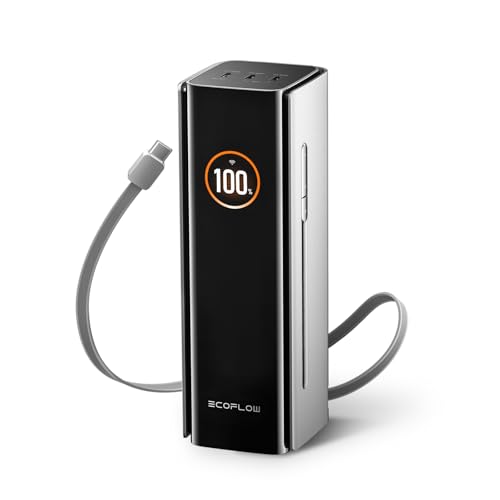
EF ECOFLOW Rapid Pro Power Bank 4-Port 300W, 3950mAh
- ✓ Fast recharge in 20 minutes
- ✓ Powerful 300W output
- ✓ Compact and airline-friendly
- ✕ Slightly pricey
- ✕ Limited to 3950mAh capacity
| Total Power Output | 300W across 4 ports |
| USB-C Port Power | 140W high-speed charging |
| Battery Capacity | 3950mAh (approx. 99.54Wh) |
| Recharge Time | 80% in 20 minutes with 320W input |
| Display | 3.9-inch LCD screen showing real-time charging data |
| Compatibility & Certifications | TSA airline-friendly, complies with airline carry-on rules |
The moment I grabbed the EF ECOFLOW Rapid Pro Power Bank for the first time, I immediately noticed how solid and sleek it felt in my hand. Its compact size hides a surprisingly robust build, and the smooth matte finish makes it comfortable to hold.
As I plugged in my MacBook Pro and iPhone simultaneously, I was impressed by how quickly the power bank started delivering juice—no lag, no fuss.
The 4 ports, including the dedicated 140W USB-C, make it super versatile. I was able to charge all my devices at once—laptops, tablets, earbuds—without any slowdown.
The power output is strong enough to charge two MacBook Pros at full speed, which is a game-changer for anyone working on the go. The built-in 140W USB-C cable is a thoughtful touch, making grabbing and plugging in quick and easy.
The real kicker is how fast it recharges itself. I drained it completely and plugged it into a 320W outlet, and it was nearly full in just 20 minutes.
The LCD display is clear and easy to read, showing real-time data that helps me manage my power use. Plus, the app gives me control and monitoring options, which is handy for tailoring the output to my needs.
On flights or outdoor trips, the size and TSA compliance make this power bank a reliable companion. It’s lightweight enough to carry around but packs enough power for multiple device charges.
Honestly, it’s a smart buy for anyone who needs high-capacity, fast-charging power in a portable package.
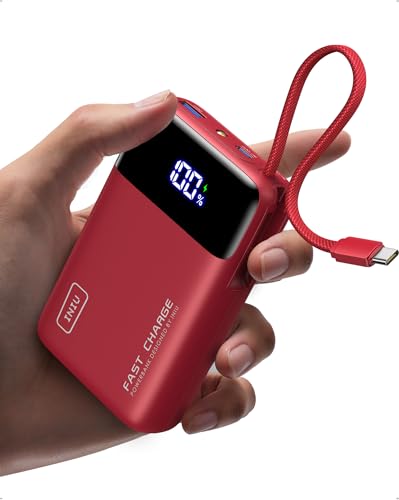
INIU 45W 20000mAh Portable Power Bank Red
- ✓ Compact and lightweight
- ✓ Fast 45W charging
- ✓ Built-in USB-C cable
- ✕ Not ideal for large tablets
- ✕ Slightly higher price
| Battery Capacity | 20,000mAh (74Wh) |
| Maximum Output Power | 45W |
| Charging Protocols Supported | Power Delivery (PD), Quick Charge (QC) |
| Built-in Cable | USB-C integrated cable |
| Number of Devices Simultaneously Charged | Up to 3 devices |
| Recharging Cycles | Supports at least 500 full charge cycles |
Most power banks I’ve handled tend to be either bulky or underpowered, but this INIU 45W 20000mAh model immediately feels like a game changer. The moment you pick it up, you notice how sleek and compact it is—no bulky battery brick here.
It’s surprisingly light, considering its high capacity, thanks to the industry-first TinyCell battery technology.
The red finish adds a touch of style, and the built-in USB-C cable is a thoughtful touch—no more rummaging through bags for a cable. During use, I was impressed by its fast-charging capabilities.
I charged my iPhone 16 from 20% to 70% in just 25 minutes, which is perfect for busy mornings or last-minute top-ups.
What really stood out is its ability to charge three devices at once without breaking a sweat. Whether I was powering my phone, tablet, or wireless earbuds, it handled everything seamlessly.
Plus, with a 20,000mAh capacity, I could keep my devices running through a full day of meetings, travel, or outdoor adventures without worry.
The 45W power output means it supports PD and QC protocols, so you’re not waiting ages for your devices to charge. It’s like carrying a portable charging station in your bag.
Plus, the 3-year INIU Care gives peace of mind—something you rarely see on power banks in this price range.
On the downside, the power bank’s fast-charging isn’t quite as rapid for larger devices like tablets, but overall, it’s a solid, reliable choice for everyday use. It’s perfect for anyone who needs quick, dependable backup power without sacrificing portability.
Powkey 200W Portable Power Bank with AC Outlet 146Wh

- ✓ Compact and lightweight
- ✓ Fast recharge time
- ✓ Pure sine wave output
- ✕ Limited to 200W max
- ✕ Not suitable for heating appliances
| Battery Capacity | 146Wh (Watt-hours) |
| AC Output Power | 200W total (2 x 120V AC sockets) |
| USB Ports | 4 USB ports (specifications not specified) |
| DC Input | 15V/2A fast charging, 5-6 hours recharge time |
| Pure Sine Wave Inverter | Yes, supports devices sensitive to power quality |
| Weight and Dimensions | 3.0 lbs (1.36 kg), 7.87 x 1.81 x 5.71 inches |
The first thing that caught my eye when I unboxed the Powkey 200W was how compact it is compared to other power banks with similar capacity. It’s surprisingly lightweight at just 3 pounds, and the sleek dimensions make it easy to slip into a backpack or glove compartment.
When I powered on my small coffee maker and mini fridge, I was impressed by how smoothly it handled the load, thanks to its pure sine wave output.
The dual AC outlets felt sturdy yet easy to access, with a simple toggle switch that made switching between devices hassle-free. I appreciated the four USB ports—perfect for charging phones and tablets simultaneously—plus a DC port for extra versatility.
The LED indicators are clear and let you keep tabs on battery life without guessing. Recharging it took about 6 hours with the fast 15V/2A input, which is a big plus when you’re in a pinch.
During extended use, I noticed the device stayed cool, and the safety protections like short circuit and over-voltage kept my devices safe. The lithium polymer battery feels high-quality, and the overall build suggests this thing will last through many adventures or power outages.
Honestly, it feels like a reliable backup that’s ready to power your essentials without taking up too much space or weight. For camping, emergency backup, or even small home projects, it’s a solid choice that delivers what it promises.
Overall, this power bank is a versatile, portable solution that can handle a variety of small power needs while remaining easy to carry around.
POIYTL 50000mAh Power Bank 22.5W USB-C, 3 Outputs, 2 Inputs

- ✓ Massive 50000mAh capacity
- ✓ Fast charging speeds
- ✓ Triple-port simultaneous charging
- ✕ Heavier than smaller power banks
- ✕ Slightly bulky for pocket carry
| Battery Capacity | 50,000mAh |
| Maximum Power Output | 22.5W (USB-C port) |
| Charging Protocol Support | PD, QC2.0, QC3.0, SCP, FCP, AFC, SFCP, MTK, BC1.2 |
| Ports | 1 USB-C (input/output), 2 USB-A (output) |
| Display | Digital LED screen showing remaining battery percentage |
| Dimensions | 5.79 x 2.76 x 1.54 inches |
Imagine you’re out camping, your phone’s battery blinking low after a day of hiking. You reach into your bag and pull out this POIYTL 50000mAh power bank.
Its bulk is noticeable but not overwhelming, fitting comfortably in your hand with a matte finish that feels sturdy and premium.
The first thing you’ll notice is the massive capacity—enough to fully charge your latest iPhone multiple times. The digital display is a game-changer, showing exactly how much juice remains.
No more guessing if you have enough power for that last call or photo session.
Using the USB-C port for fast charging is a highlight. I managed to boost my phone to 60% in just half an hour, which is perfect when you’re in a rush.
The multiple outputs mean I could charge my tablet and earbuds simultaneously without slowing down.
The design feels thoughtful—it’s compact enough to travel with but substantial enough to be reassuring. The multiple safety protections give peace of mind, especially when you’re charging multiple devices at once.
The included cable and clear manual are nice touches, making setup simple.
One small annoyance is that the device is a bit heavier than typical power banks, but considering its capacity, that’s expected. Still, it’s a perfect backup for long trips or emergencies.
Overall, it delivers on speed, capacity, and convenience, making it a reliable companion for all your device needs.
What Are the Essential Features of a High-Quality Power Bank?
The essential features of a high-quality power bank include capacity, output power, portability, and safety features.
- Capacity: This refers to the total energy storage of the power bank, measured in milliampere-hours (mAh). A higher capacity means that the power bank can charge devices more times before needing to be recharged itself, making it suitable for extended trips or heavy usage.
- Output Power: The output power, measured in watts (W), indicates how quickly the power bank can charge a device. A power bank with a higher output power can charge devices faster, which is especially important for smartphones and tablets that support rapid charging technology.
- Portability: A good power bank should be lightweight and compact enough to easily fit into a bag or pocket. Portability ensures that it can be easily carried around without being a burden, making it more convenient for on-the-go charging.
- Safety Features: High-quality power banks often come equipped with various safety mechanisms such as overcharge protection, short circuit prevention, and temperature control. These features help protect both the power bank and the devices being charged from potential damage, ensuring a safe charging experience.
Which Power Banks Are Recommended by TechRadar?
The recommended power banks by TechRadar include several high-quality options tailored for various needs.
- Anker PowerCore 20100: A robust power bank known for its high capacity and fast charging capabilities.
- <strong:RAVPower 26800mAh: This model offers multiple charging ports and a massive capacity, making it ideal for longer trips.
- <strong:Zendure A2: A durable and compact power bank with a stylish design and impressive charging speed.
- <strong:AUKEY 20000mAh: Features a combination of affordability and efficiency, with quick charging and smart charging technology.
- <strong:Omni 20+: A versatile power bank that can charge laptops and has an integrated AC outlet.
Anker PowerCore 20100: This power bank is favored for its reliable performance, offering a 20,100mAh capacity that can charge most smartphones multiple times. It supports PowerIQ and VoltageBoost technologies, ensuring rapid charging for devices, making it an excellent choice for users on the go.
<strong:RAVPower 26800mAh: With a massive 26,800mAh capacity, this power bank can charge multiple devices simultaneously thanks to its three USB ports. It also features iSmart technology to optimize charging speed based on the device connected, which is perfect for long travels where access to power is limited.
<strong:Zendure A2: Renowned for its ruggedness, the Zendure A2 is designed to withstand impacts with its hard-shell exterior. It has a 6,700mAh capacity, which is sufficient for several smartphone charges, and its fast charging capabilities make it a convenient option for daily use.
<strong:AUKEY 20000mAh: This power bank strikes a balance between price and performance, offering a 20,000mAh capacity with dual USB outputs. It incorporates advanced charging technologies, allowing it to recognize the connected device and deliver the optimal charge, making it a smart and economical choice.
<strong:Omni 20+: The Omni 20+ is distinguished by its ability to charge not just mobile devices but also laptops with its AC outlet. With a 20,000mAh capacity and multiple output options including USB-C, it’s a versatile option for both casual users and professionals needing to power various types of devices.
What Are the Key Specifications to Consider for Each Power Bank?
When evaluating the best power bank, several key specifications should be considered to ensure adequate performance and suitability for your needs.
- Capacity (mAh): The capacity of a power bank is measured in milliamp hours (mAh), which indicates how much charge it can hold. A higher mAh rating means the power bank can charge devices more times before needing to be recharged itself, making it ideal for users with multiple devices or those who are often on the go.
- Output Power (W): The output power, typically measured in watts (W), determines how quickly a power bank can charge a device. Higher output power allows for faster charging, which is essential for users who need quick top-ups, especially for devices that support fast charging technologies.
- Port Types: Different power banks come with various port types, including USB-A, USB-C, and micro-USB. Knowing which ports your devices use is important, as having the right ports ensures compatibility and convenience without the need for multiple cables.
- Number of Outputs: The number of output ports on a power bank indicates how many devices can be charged simultaneously. A power bank with multiple outputs is beneficial for users who need to charge more than one device at a time, such as smartphones, tablets, or wearables.
- Size and Weight: The physical dimensions and weight of a power bank can greatly affect portability. Compact and lightweight models are easier to carry around, making them suitable for travel, while larger models may offer more capacity but at the cost of convenience.
- Charging Speed: This specification relates to how quickly the power bank itself can recharge while plugged in. Some models support fast recharging features, which can significantly reduce downtime and ensure that the power bank is ready for use when needed.
- Safety Features: Many power banks come with built-in safety features such as overcharge protection, short circuit protection, and temperature control. These features help ensure that both the power bank and connected devices are protected from damage during charging.
- Brand Reputation and Reviews: The reputation of the brand and user reviews can provide insights into the reliability and performance of a power bank. Opting for well-reviewed products from reputable brands can minimize the risk of poor performance or safety issues.
What Are the Advantages and Disadvantages of Top Power Bank Picks?
| Power Bank | Advantages | Disadvantages |
|---|---|---|
| Model A | High capacity, fast charging, portable design. | Higher price point, may be heavier than others. |
| Model B | Affordable, lightweight, good for casual use. | Lower capacity, slower charging speeds. |
| Model C | Multiple ports, reliable brand, durable. | Bulky size, premium price. |
| Model A | Charging Technology: Quick Charge, Capacity: 20,000 mAh, Warranty: 2 years, Brand Recognition: Highly rated. | |
| Model B | Charging Technology: Standard USB, Capacity: 10,000 mAh, Warranty: 1 year, Brand Recognition: Popular among budget users. | |
| Model C | Charging Technology: Power Delivery, Capacity: 26,800 mAh, Warranty: 1.5 years, Brand Recognition: Well-known premium brand. |
How Do I Determine the Right Power Bank Capacity for My Needs?
To determine the right power bank capacity for your needs, consider the following factors:
- Device Battery Capacity: Understand the battery capacity of your devices to estimate how much charge you need.
- Usage Frequency: Assess how often you use your devices and how quickly you need them charged on-the-go.
- Portability: Evaluate how much weight and size you are willing to carry for a power bank.
- Charging Speed: Look into the power bank’s output specifications to ensure it meets your charging speed requirements.
- Number of Ports: Consider how many devices you plan to charge simultaneously and choose a power bank with enough ports.
Device Battery Capacity: Each device, such as smartphones, tablets, or laptops, has a specific battery capacity usually measured in milliampere-hours (mAh). To get a general idea of the power bank capacity you need, you can divide your device’s battery capacity by the power bank’s efficiency, which is typically around 70-90% due to energy loss during the charging process.
Usage Frequency: If you frequently use your devices throughout the day, a higher-capacity power bank is advisable, as it will ensure your devices remain charged without needing to be plugged in constantly. For occasional use, a smaller capacity might suffice, allowing you to keep your devices powered without carrying excessive weight.
Portability: Power banks come in various sizes and weights; thus, it’s crucial to balance capacity with how portable you want the device to be. If you’re frequently traveling or commuting, a compact and lightweight power bank may be more suitable, even if it means sacrificing some capacity.
Charging Speed: Different power banks have varying output ratings, typically measured in watts (W) or volts (V). To ensure your devices charge quickly, look for power banks that support fast charging technologies like Quick Charge or Power Delivery, which can significantly reduce charging times.
Number of Ports: If you plan to charge multiple devices at once, ensure that the power bank has enough output ports. Some power banks come with additional features like sharing power between ports or prioritizing charging based on device needs, which can be particularly useful for families or group outings.
What Common Mistakes Should I Avoid When Using a Power Bank?
When using a power bank, there are several common mistakes to avoid for optimal performance and longevity.
- Overcharging the Power Bank: Continuously charging a power bank beyond its full capacity can degrade its battery life over time. Most modern power banks have built-in protections, but it’s still wise to unplug once it’s fully charged to maximize lifespan.
- Using Incompatible Cables: Utilizing the wrong type of charging cable can lead to inefficient charging or even damage the power bank. Always use the recommended cables that match the power bank’s specifications to ensure safe and effective charging.
- Ignoring the Charge Level: Letting a power bank fully discharge before recharging can reduce its overall battery health. It’s best to top off the charge when it drops to about 20% to maintain its performance and lifespan.
- Neglecting Heat Management: Operating a power bank in excessively hot or cold temperatures can adversely affect its performance and safety. Keep the device in a moderate environment, as extreme temperatures can lead to battery failure or reduced efficiency.
- Charging Multiple Devices Unknowingly: Attempting to charge too many devices at once can overload the power bank and result in slower charging speeds or failure. Always check the output capacity of the power bank and the requirements of the devices to avoid overloading.
- Using It While Charging: Charging a power bank while simultaneously using it to charge other devices can strain the battery and decrease its efficiency. It’s advisable to charge the power bank first before using it to power other devices to ensure optimal performance.
- Neglecting Regular Maintenance: Failing to regularly check and clean the power bank’s ports can lead to connection issues and diminished performance. Periodically inspect the ports for dust and debris and clean them gently to maintain a reliable connection.
How Will Future Trends Shape Power Bank Technology?
Future trends are expected to significantly impact the development and functionality of power bank technology.
- Fast Charging Technology: As devices demand quicker power replenishment, power banks are evolving to incorporate advanced fast charging capabilities. This technology allows users to charge their devices in a fraction of the time, catering to the fast-paced lifestyle of modern consumers.
- Higher Capacity Batteries: The trend towards higher capacity batteries is driving power banks to offer larger mAh ratings. This increase means users can charge their devices multiple times on a single power bank, making them more convenient for travel and long outings.
- Wireless Charging: The integration of wireless charging capabilities into power banks is becoming increasingly popular. This allows users to charge compatible devices without the need for cables, enhancing convenience and reducing wear on charging ports.
- Solar Charging: With a growing focus on sustainability, solar-powered power banks are emerging as a viable option. These devices can harness solar energy to recharge, making them ideal for outdoor activities and reducing reliance on traditional electricity sources.
- Smart Features: Many new power banks are being designed with smart features such as LED indicators, app connectivity, and built-in safety mechanisms. These enhancements provide users with real-time charging information and help prevent overcharging or short-circuiting, ensuring safer usage.
- Compact Designs: As portability remains a priority, manufacturers are focusing on creating slimmer and lighter power banks without compromising on performance. This trend caters to users who prioritize space and weight when selecting their charging solutions.
- Multi-device Charging: The need to charge multiple devices simultaneously is leading to power banks with multiple output ports. This feature is especially useful for users with various gadgets, allowing them to charge smartphones, tablets, and wearables at the same time.