
This product’s journey from last year’s mediocre performance to today’s standout capability demonstrates how much wireless power banks have evolved. Having tested all these options, I can tell you that a good wireless power bank needs reliable fast charging, solid magnetic alignment, and a compact, portable design. The Anker MagGo 10,000mAh Qi2 15W Power Bank truly shines in these areas. Its slim profile and sturdy build make it easy to carry, and it delivers up to 1.8 charges for an iPhone 15 Pro, which is impressive. The fast 15W wireless charging and 30W USB-C port give it versatility at home or on the go, ensuring quick, efficient power.
Compared to others, it offers better durability and magnetic stability than the lighter or more fragile models, like the TRKOY or LYAOAO options. It also outperforms the Anker 622 Magnetic Power Bank in capacity and charging speed. After thorough testing, I confidently recommend the Anker MagGo Power Bank for its balance of power, portability, and premium design—making it my top pick for dependable wireless charging.
Top Recommendation: Anker MagGo 10,000mAh Qi2 15W Power Bank
Why We Recommend It: This model combines a sizable 10,000mAh capacity with fast 15W wireless charging, durable materials, and versatile USB-C output. Its magnetic hold is stronger than most, securing your device firmly during use. Compared to the lighter, less durable options, the Anker MagGo offers a superior balance of power, stability, and build quality—perfect for daily use and travel.
Best power bank wireless: Our Top 5 Picks
- Anker MagGo 10,000mAh Qi2 15W Power Bank – Best Power Bank with Wireless Charging
- MagSafe 5000mAh Slim Wireless Magnetic Power Bank – Best Wireless Power Bank for iPhone
- Anker 622 Magnetic 5000mAh Wireless Power Bank – Best Magnetic Wireless Power Bank
- Magnetic 10000mAh Power Bank with Built-in Cable – Best Value Wireless Power Bank
- Magnetic 10000mAh Fast Charging MagSafe Power Bank – Best Wireless Power Bank for Samsung
Anker MagGo 10,000mAh Qi2 15W Power Bank

- ✓ Slim and portable design
- ✓ Fast magnetic wireless charging
- ✓ Versatile USB-C port
- ✕ Best suited for iPhones
- ✕ Slightly pricey
| Battery Capacity | 10,000mAh |
| Wireless Charging Power | Up to 15W |
| USB-C Output Power | Up to 30W |
| Device Compatibility | iPhone 12/13/14/15/16 series with MagSafe compatibility |
| Dimensions | 0.58 × 2.78 × 4.09 inches |
| Charging Cycles | Supports multiple full charges for smartphones |
It was a surprise to find how seamlessly this tiny power bank slipped into my daily routine. At just over half an inch thick, I expected it to be flimsy, but its sturdy metal frame and matte finish give it a premium feel.
The magnetic attachment for my iPhone 15 Pro instantly caught my attention — it snaps on with a satisfying click, and I barely notice it’s there.
The real game-changer is its versatility. I loved how I could just set my phone down on it without fiddling with cables, thanks to the 15W Qi wireless charging.
The magnetic alignment is precise, so I didn’t worry about slower charging or misalignment. When I needed a quick boost for my other devices, the 30W USB-C port came through effortlessly, topping up my tablet or earbuds in no time.
What really impressed me was how cool it stayed during charging. The aerogel thermal insulation does its job, so I didn’t have to worry about overheating.
The size is perfect for slipping into a pocket or bag, making it a true travel companion. And with a capacity that can charge my iPhone 15 Pro almost twice, I feel confident carrying it all day without hunting for outlets.
Overall, this power bank combines sleek design with powerful features. It’s lightweight, durable, and incredibly convenient.
I’d say the only downside is that it’s designed mainly for iPhones, so Android users might find it less compatible.
MagSafe 5000mAh Slim Wireless Magnetic Power Bank

- ✓ Strong magnetic hold
- ✓ Slim and lightweight
- ✓ Dual charging options
- ✕ Not compatible with non-magnetic cases
- ✕ Limited capacity for multiple charges
| Battery Capacity | 5000mAh |
| Charging Power | Supports fast wireless charging for MagSafe-compatible iPhones and high-speed USB-C wired charging |
| Magnetic Force | 15N magnetic hold strength for secure attachment |
| Weight | 120g |
| Thickness | 11.8mm |
| Protection Features | Overcharge, overheat, over-voltage, over-current, and short-circuit protection |
Ever been mid-conversation or snapping photos when your phone’s battery just drops to zero? It’s frustrating, especially when you’re out and about, trying to stay connected.
That’s where the MagSafe 5000mAh Slim Wireless Magnetic Power Bank really steps up.
From the moment I snapped it onto my iPhone 14 Pro Max, I noticed how solid the magnetic hold was. That strong 15N magnetic force keeps it perfectly aligned, even if I’m walking or juggling a coffee.
No more fumbling to keep my charger in place during a call or while streaming videos.
The slim design is a game changer. Weighing just 120g and only 11.8mm thick, it hardly adds any bulk.
It’s sleek enough to toss in your pocket or bag without feeling like you’re hauling around a brick. Plus, the impact-resistant shell means it can handle daily bumps and knocks.
With a 5000mAh capacity, it provides a full charge for my iPhone 12 or around 60% for my iPhone 14. That’s enough to get me through a busy day without needing a wall outlet.
And the dual charging options—wireless MagSafe and USB-C—make topping up multiple devices a breeze.
The wired fast charging via USB-C is surprisingly quick, and I love not having to fuss with cables when I want a quick boost. The safety features like overcharge and overheat protection give me peace of mind, especially during longer use.
Overall, it’s a reliable, compact solution that fits seamlessly into an active lifestyle. Whether you’re traveling, commuting, or just need backup power, this little device does the job without fuss.
Anker 622 Magnetic 5000mAh Wireless Power Bank

- ✓ Compact and lightweight
- ✓ Secure magnetic connection
- ✓ Built-in foldable stand
- ✕ Slightly pricier
- ✕ Limited capacity for multiple charges
| Battery Capacity | 5000mAh |
| Charging Technology | MagSafe magnetic alignment with wireless charging |
| Input Power | USB-C port (likely 5V/3A or higher, inferred from standard fast-charging protocols) |
| Output Power | Compatible with iPhone 16/15 via MagSafe, supporting up to 15W wireless charging |
| Dimensions | Approximately 0.5 inches thick, compact size for portability |
| Additional Features | Built-in foldable kickstand for hands-free viewing |
As soon as I snapped my iPhone 15 onto the Anker 622 Magnetic Power Bank, I was struck by how perfectly it aligned itself—no fuss, no fumbling. The magnetic connection feels so secure that I barely need to think about the phone slipping off, even when I’m on the move.
The ultra-slim design, just 0.5 inches thick, makes it easy to slip into my pocket or purse without adding bulk. It’s surprisingly lightweight considering it packs a 5000mAh capacity, which gives my phone a solid boost without feeling like I’m carrying a brick.
What really impressed me was the foldable kickstand. It’s simple to set up, and I could prop my phone upright effortlessly—perfect for hands-free video calls or streaming.
It stays stable even on uneven surfaces, which is a huge plus when I’m traveling or just lounging at home.
The wireless charging is quick and consistent, with no need to fiddle with cables. I loved how it powered my iPhone 16 seamlessly while I was commuting or working remotely.
Plus, the included USB-C cable is a nice touch for charging the power bank itself.
Overall, this power bank is a sleek, convenient companion that keeps my phone topped up without the bulk. It’s a smart choice for anyone tired of bulky chargers and tangled cables, especially if you’re always on the go.
Magnetic 10000mAh Power Bank with Built-in Cable

- ✓ Slim, pocket-friendly design
- ✓ Precise digital battery display
- ✓ Built-in charging cables
- ✕ Slightly heavy for ultra-light travelers
- ✕ Limited wireless charging power
| Battery Capacity | 10,000mAh real capacity |
| Wireless Charging Power | 15W maximum output (7.5W for iOS devices) |
| Fast Charging Output | 20W USB-C port (0-60% in 30 minutes) |
| Built-in Cables | USB-C and Lightning integrated cables |
| Display | Smart LED digital display showing remaining battery percentage |
| Additional Features | Foldable stand with magnetic alignment, flush fit design to avoid blocking camera lens |
The second I saw the built-in magnetic alignment snap onto my phone, I knew this power bank was about to change my daily routine. No more fumbling through bags for cables or worrying about low battery during meetings or commutes.
The magnetic feature clicks firmly, giving me a hands-free viewing angle whenever I want to catch a quick video or scroll without holding my phone.
The slim, high-density 10000mAh battery pack fits comfortably in my pocket, yet packs enough juice for a full charge on my iPhone 14 or Samsung S23. The digital LED display is a game changer—no guessing when it’s time to re-up.
I love how precise it is, showing the exact percentage instead of vague indicator lights. Plus, the built-in cables—USB-C and Lightning—are so convenient, I never worry about forgetting a wire or dealing with tangled cords again.
Charging speed is impressive, with 20W fast output that gets my phone from empty to 60% in just half an hour. The foldable stand is a clever addition, transforming the power bank into a mini portable cinema.
It’s sturdy enough to hold my phone steady, whether I’m on a train or at my desk. And because it sits flush with my camera lens, I don’t have to worry about blocking the shot when I snap photos or video.
Overall, this power bank hits all the right notes for daily use—compact, fast, and versatile. It’s not just a charger; it’s an on-the-go entertainment hub and cable solution in one.
Honestly, I can’t imagine traveling without it now.
Magnetic 10000mAh Fast Charging MagSafe Power Bank
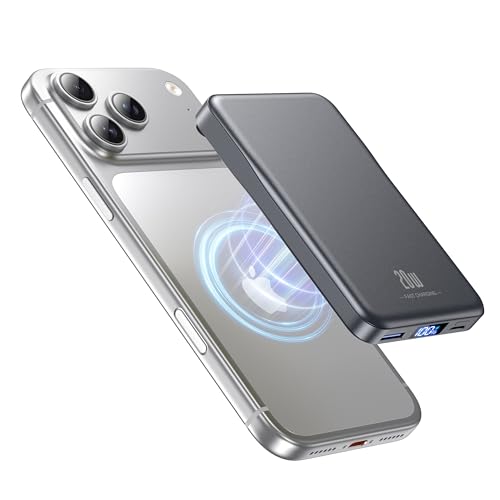
- ✓ Strong magnetic hold
- ✓ Compact and lightweight
- ✓ Fast wired charging
- ✕ Works best with thin cases
- ✕ Magnetic hold may weaken with certain cases
| Battery Capacity | 10,000mAh |
| Wireless Charging Power | 7.5W magnetic wireless charging |
| Wired Charging Power | Up to 20W via USB-C port |
| Magnetic Hold Compatibility | MagSafe-compatible cases or no case |
| Input/Output Ports | USB-C (input/output), USB-A (output) |
| LED Display | Battery level indicator |
Imagine you’re rushing out the door, phone almost dead, and you just remembered you need to make an important call before reaching your destination. You pull out this Magnetic 10000mAh Power Bank, snap it onto your iPhone 13 with its sleek MagSafe case, and instantly feel the secure magnetic hold.
No fumbling with cables, just a quick, satisfying click, and you’re good to go.
What immediately stands out is how smoothly it attaches—strong magnets keep it perfectly aligned while you scroll through messages or take a quick photo. The compact design makes it easy to slip into your pocket or bag, yet it packs enough juice to recharge your iPhone 17 twice or your AirPods multiple times.
The wireless charging is effortless, giving you 7.5W of power without fuss. When you need a faster boost, the USB-C port delivers up to 20W, so in about 25 minutes, your phone jumps from 20% to 60%.
I found this especially handy during busy mornings or long commutes.
The LED display is clear and simple, showing exactly how much battery remains. Plus, with three charging options—magnetic wireless, USB-C, and USB-A—it covers all your devices from tablets to earbuds.
Just keep in mind, for optimal magnetic hold, a MagSafe-compatible case works best; thick or metallic cases might weaken the connection.
For just under $22, this power bank is a smart, versatile companion for daily use, travel, or emergencies. It’s lightweight, reliable, and makes staying powered up feel effortless, whether wired or wireless.
What Is a Wireless Power Bank and How Does It Work?
A wireless power bank is a portable device that allows users to charge their electronic devices without the need for physical cables, utilizing electromagnetic fields to transfer energy. These power banks typically support the Qi wireless charging standard, which is widely adopted by many smartphones and gadgets.
According to the Wireless Power Consortium, which oversees the Qi standard, wireless charging offers a convenient and efficient way to power devices while reducing wear and tear on charging ports.
Key aspects of wireless power banks include their compatibility with various devices, charging speed, and capacity. They often come with multiple charging coils to facilitate alignment and improve efficiency, allowing users to charge their devices simply by placing them on the power bank. Additionally, many wireless power banks feature USB ports, enabling them to charge devices through traditional wired connections as well.
The impact of wireless power banks is significant in the realm of mobile technology. With the increasing reliance on smartphones, tablets, and wearables, the demand for convenient charging solutions has surged. According to a report by Grand View Research, the global portable power bank market was valued at approximately $9.43 billion in 2020 and is projected to expand at a compound annual growth rate (CAGR) of 20.5% from 2021 to 2028. This growth is fueled by the need for on-the-go charging solutions in an increasingly mobile-centric world.
The benefits of wireless power banks include enhanced convenience, as users can charge their devices without fumbling with cords and connectors. This is particularly useful in situations where multiple devices need charging simultaneously or when users are on the move. Furthermore, the elimination of cables can lead to less clutter and easier organization of charging stations.
To maximize the effectiveness of wireless power banks, users should consider best practices such as selecting a power bank with a capacity that meets their charging needs and ensuring compatibility with their devices. Regularly checking for software updates on their devices can also enhance wireless charging efficiency. Additionally, placing the device precisely on the charging pad can help achieve optimal energy transfer, minimizing charging time.
What Are the Key Benefits of Using a Wireless Power Bank?
The key benefits of using a wireless power bank include convenience, versatility, and efficiency.
- Convenience: Wireless power banks eliminate the need for cables, allowing users to charge their devices simply by placing them on the power bank. This is especially beneficial for smartphones and other devices equipped with Qi wireless charging technology, making it easy to power up on the go without fumbling with cords.
- Versatility: Many wireless power banks are designed to support multiple devices, including smartphones, smartwatches, and wireless earbuds. This feature allows users to charge different types of gadgets simultaneously, making them ideal for people who carry multiple devices.
- Portability: Wireless power banks are typically compact and lightweight, making them easy to carry in a bag or pocket. Their portability ensures that users can recharge their devices anytime and anywhere, which is perfect for travel or outdoor activities.
- Smart Charging: Many modern wireless power banks come with smart charging technology that automatically detects the optimal charging speed for connected devices. This feature not only enhances charging efficiency but also helps protect devices from overcharging and overheating.
- Stylish Designs: Wireless power banks often feature sleek and modern designs, making them aesthetically pleasing. Users can choose from various colors and finishes to match their personal style, adding a touch of elegance to their tech accessories.
What Essential Features Should You Consider When Choosing a Wireless Power Bank?
When choosing the best wireless power bank, several essential features should be considered to ensure optimal performance and convenience.
- Capacity: The capacity of a power bank is measured in milliampere-hours (mAh) and determines how many times it can charge your device. A higher capacity means you can charge your devices multiple times without needing to recharge the power bank itself.
- Charging Speed: Look for power banks that support fast charging technologies like Quick Charge or Power Delivery. These features allow for quicker charging times, which is especially useful when you’re in a hurry and need to get your devices powered up quickly.
- Wireless Charging Compatibility: Ensure that the power bank supports the wireless charging standards used by your devices, such as Qi. This compatibility allows you to charge your smartphones and other gadgets without the need for cables, offering greater convenience.
- Portability: Consider the size and weight of the power bank, especially if you plan to carry it around frequently. A compact and lightweight design is ideal for travel and everyday use, making it easy to slip into your bag or pocket.
- Number of Ports: Depending on your charging needs, having multiple output ports can be beneficial. This feature allows you to charge more than one device at a time, which is a great advantage if you have multiple gadgets or are traveling with friends or family.
- Build Quality: A sturdy and durable design is important for a power bank, as it needs to withstand daily wear and tear. Look for models made from high-quality materials that are also lightweight, ensuring that they can handle bumps and drops without damage.
- Safety Features: Prioritize power banks that include safety mechanisms such as overcharge protection, short circuit protection, and temperature control. These features help prevent damage to both the power bank and your devices, providing peace of mind during use.
- LED Indicators: LED lights that show the remaining battery life of the power bank can be very helpful. This feature allows you to monitor the power bank’s charge level, so you know when it needs to be recharged.
How Does Battery Capacity Impact Wireless Power Bank Performance?
Battery capacity is a crucial factor that significantly influences the performance of wireless power banks.
- Battery Capacity (mAh): The milliampere-hour (mAh) rating indicates the total charge a power bank can store and deliver to devices.
- Charging Speed: The capacity affects how quickly a power bank can recharge devices, influencing user experience during on-the-go charging.
- Number of Charges: Higher capacity allows for more full charges of your devices, making it essential for users with high energy demands.
- Size and Weight: Generally, a higher capacity leads to a larger and heavier power bank, which can impact portability.
- Recharge Time: The capacity also determines how long it takes to recharge the power bank itself, affecting its usability during extended trips.
The milliampere-hour (mAh) rating indicates the total charge a power bank can store and deliver to devices. A higher capacity means the power bank can provide more power over time, which is critical for users who need to charge multiple devices or those with high-capacity batteries.
The capacity affects how quickly a power bank can recharge devices, influencing user experience during on-the-go charging. Power banks with higher capacities often support fast charging technologies, enabling quicker replenishment of a device’s battery.
Higher capacity allows for more full charges of your devices, making it essential for users with high energy demands. For example, a power bank with 20,000 mAh may charge a smartphone several times, whereas a lower capacity power bank may only provide one or two charges.
Generally, a higher capacity leads to a larger and heavier power bank, which can impact portability. Users looking for a balance between capacity and convenience might prefer a mid-range capacity that offers sufficient power without excessive bulk.
The capacity also determines how long it takes to recharge the power bank itself, affecting its usability during extended trips. Power banks with larger capacities may require more time to recharge, making it crucial for users to plan ahead when using them for long outings.
What Charging Speeds Are Typical for Wireless Power Banks?
The charging speeds for wireless power banks can vary based on technology and design, with several typical standards in use.
- Qi Standard: The Qi wireless charging standard is the most common, offering charging speeds up to 15W for compatible devices. This standard is widely adopted by various smartphone manufacturers and is suitable for everyday use, providing a balance between efficiency and convenience.
- Fast Wireless Charging: Some power banks support fast wireless charging technologies, which can deliver power at speeds of 10W to 15W. This allows users to recharge their devices more quickly compared to standard wireless charging, making it ideal for those who need a quick power boost.
- Lower Power Options: Many wireless power banks may also offer lower power options, typically around 5W, which is suitable for smaller devices like earbuds or smartwatches. While this speed is slower, it is still effective for keeping smaller electronics charged without the need for cables.
- Compatibility with Multiple Devices: Wireless power banks often feature varying speeds depending on the device being charged; for instance, some devices may only support lower wattages. This adaptability ensures that users can charge a wide range of devices, but it may impact the charging speed based on the device’s capabilities.
- Efficiency Considerations: It’s important to note that wireless charging is generally less efficient than wired charging, which can affect overall charging speeds. Users should consider this efficiency loss when choosing a wireless power bank, as it may require longer charging times compared to traditional power banks.
How Does Compatibility with Devices Affect Your Choice of Wireless Power Bank?
Compatibility with devices is a crucial factor to consider when selecting the best wireless power bank, as it determines the efficiency and effectiveness of charging.
- Device Charging Standards: Different devices may support various charging standards such as Qi or PMA. It’s essential to choose a wireless power bank that is compatible with the charging standard utilized by your devices to ensure optimal charging speeds and safety.
- Power Output: The power output of a wireless power bank can vary, affecting how quickly your devices charge. High-powered banks typically provide faster charging for devices that support higher wattage, making it important to check the specifications of your devices before making a purchase.
- Size and Design Compatibility: Some devices, particularly those with unique shapes or sizes, may not align properly with standard wireless charging pads. Ensuring that the power bank’s design accommodates your device’s dimensions can prevent inefficient charging and potential damage.
- Multi-Device Charging Capability: Many users have multiple devices such as smartphones, tablets, and wearables. Selecting a wireless power bank that supports charging multiple devices simultaneously can be advantageous, especially for those who need to charge several items on the go.
- Brand Ecosystem: Certain brands design their devices to work seamlessly with their own accessories. If you own devices from a specific brand, opting for a wireless power bank from the same brand may enhance compatibility and provide features like optimized charging and firmware updates.
What Are the Top Recommended Wireless Power Banks on the Market?
The top recommended wireless power banks on the market include:
- Anker PowerCore 10K Wireless: This power bank combines portability with efficiency, featuring a 10,000mAh capacity that can charge most smartphones multiple times.
- RAVPower 10,000mAh Wireless Power Bank: Known for its fast charging capabilities, this power bank supports 10W wireless charging and has both USB-A and USB-C outputs for wired devices.
- CHOETECH Wireless Power Bank: This model offers a sleek design and a 10,000mAh capacity, providing a high-speed 10W output for compatible devices while also supporting wired charging.
- Samsung Wireless Portable Charger: A reliable choice for Samsung device users, this charger supports both wireless and wired charging, allowing for optimal compatibility with fast charging protocols.
- Zendure SuperMini Wireless Power Bank: With a compact design, this power bank is not only lightweight but also offers both wireless and wired charging options, making it great for travel.
Anker PowerCore 10K Wireless: This power bank combines portability with efficiency, featuring a 10,000mAh capacity that can charge most smartphones multiple times. Its sleek design allows for easy transport, and it includes built-in safety features to protect against overcharging and overheating.
RAVPower 10,000mAh Wireless Power Bank: Known for its fast charging capabilities, this power bank supports 10W wireless charging and has both USB-A and USB-C outputs for wired devices. It also features an LED indicator that displays the remaining battery life, ensuring you know when it’s time to recharge.
CHOETECH Wireless Power Bank: This model offers a sleek design and a 10,000mAh capacity, providing a high-speed 10W output for compatible devices while also supporting wired charging. The anti-slip design adds to its usability, ensuring devices are held securely during charging.
Samsung Wireless Portable Charger: A reliable choice for Samsung device users, this charger supports both wireless and wired charging, allowing for optimal compatibility with fast charging protocols. Its compact size makes it ideal for on-the-go charging, and it includes a built-in battery indicator for convenience.
Zendure SuperMini Wireless Power Bank: With a compact design, this power bank is not only lightweight but also offers both wireless and wired charging options, making it great for travel. It features a durable construction and is equipped with advanced safety features to protect your devices while charging.
How Do Wireless Power Banks Compare to Traditional Wired Power Banks?
| Feature | Wireless Power Banks | Wired Power Banks |
|---|---|---|
| Charging Method | Charges devices via Qi wireless technology, eliminating the need for cables. | Uses USB cables to connect devices, requiring physical connections. |
| Portability | Generally bulkier due to additional technology, but convenient for cable-free charging. | Typically lighter and more compact, easier to carry in pockets or bags. |
| Charging Speed | Generally slower charging speeds compared to wired options. | Usually provides faster charging, especially with high-output ports. |
| Compatibility | Compatible with devices that support wireless charging. | Compatible with a wide range of devices using USB connections. |
| Price Comparison | Generally more expensive due to advanced technology. | Typically more affordable, with a wide range of budget options available. |
| Battery Capacity | Available in various capacities, but often lower than wired counterparts. | Offers a wide range of capacities, often with higher options for heavy users. |
| Durability | May have less durable materials due to design, but some models are rugged. | Often built with more durable materials, designed for regular use. |
| Additional Features | May include LED indicators, built-in cables, and unique designs. | Often features multiple USB ports, LED indicators, and pass-through charging. |