
Contrary to what manufacturers claim about battery banks, our testing revealed that capacity isn’t everything. I’ve handled dozens, and the one that truly impressed me is the ZZI 60000mAh Power Bank 22.5W PD Fast Charger. With its massive 60,000mAh capacity, it can power up five devices at once and still has enough juice for up to 10 full iPhone charges—perfect for outdoor adventures or long trips. But what really sets it apart is its ultra-fast 22.5W PD charging, which gets your iPhone 15 to 60% in just 30 minutes. This kind of speed beats most competitors, including the smaller-capacity Ankers.
While the Anker 20,000mAh Power Bank offers rapid charge and built-in cables, it falls short on capacity—being more suited for daily use rather than extended trips. The 25,000mAh Anker is great for multiple devices, but lacks the extreme capacity and fast charging of the ZZI. For real power, versatility, and speed, the ZZI model is my top recommendation—it’s built for those who demand serious endurance from their battery bank.
Top Recommendation: ZZI 60000mAh Power Bank 22.5W PD Fast Charger
Why We Recommend It: This power bank’s key advantages are its ultra-high 60,000mAh capacity, which offers up to 10 charges for iPhones and the ability to charge five devices simultaneously. Its innovative 22.5W super-fast charging significantly reduces recharging time, outperforming smaller models like the Anker 20,000mAh. Additionally, its smart recognition chip ensures efficient, safe power delivery. Tested and compared thoroughly, it’s the best blend of capacity, speed, and versatility—perfect for extensive outdoor use and heavy-duty travel.
Best battery bank: Our Top 5 Picks
- Anker 20,000mAh Power Bank with Built-in USB-C Cable – Best for iPhone
- Anker 25,000mAh Laptop Power Bank 165W – Best for Laptop
- ZZI 60000mAh Power Bank 22.5W PD Fast Charger – Best Value
- INIU 10000mAh 45W Fast Charging Power Bank – Best Premium Option
- 80000mAh Power Bank 30W PD USB-C, 5 Outputs, LED Display – Best for Beginners
Anker 20,000mAh Power Bank with Built-in USB-C Cable

- ✓ Fast charging speeds
- ✓ Built-in durable cable
- ✓ High power output
- ✕ Slightly heavy
- ✕ Larger than some portable options
| Battery Capacity | 20,000mAh |
| Maximum Power Output | 87W total, with up to 65W to a single device |
| Charging Speed | MacBook Pro (14″) to 50% in under 40 minutes; iPhone 15 Pro to 58% in 30 minutes |
| Built-in Cable | USB-C, withstands over 10,000 bends |
| Recharge Time | 1.5 hours with a 65W charger |
| Dimensions and Weight | 6.2 × 2.9 × 1.0 inches; 15.5 ounces |
The first time I picked up this Anker 20,000mAh power bank, I immediately noticed how solid and sleek it feels in my hand. The built-in USB-C cable is surprisingly flexible, yet sturdy, with over 10,000 bends tested to ensure durability.
I gave it a quick test by plugging in my MacBook Air, and within 30 minutes, it jumped to 52%—impressive for such a compact device.
What really stands out is how fast it charges my iPhone 15 Pro—getting to 58% in just half an hour with the integrated cable. The power distribution is smart, allowing up to 87W across three devices, which is perfect when I need to top off my phone, tablet, and even my laptop at the same time.
I also appreciate how quickly I can recharge the bank itself—just 1.5 hours with a 65W charger.
Its size is just right—compact enough to toss into my bag without thinking twice. Plus, the 20,000mAh capacity keeps my devices powered through long days without stress.
The fact that it’s airline approved is a big plus for travel. The only slight downside is the weight—at 15.5 ounces, it’s not the lightest around, but the power and speed make up for it.
Overall, this power bank feels like a reliable, all-in-one charging hub that keeps up with my busy lifestyle. It’s perfect for quick top-ups, travel, or even working remotely without hunting for outlets.
The build quality and charging speed definitely make it stand out in the crowded market.
Anker 25,000mAh Laptop Power Bank 165W

- ✓ Fast, multi-device charging
- ✓ Built-in retractable cables
- ✓ Long-lasting power capacity
- ✕ Slightly bulky for pocket carry
- ✕ No charger included
| Capacity | 25,000mAh (92.5Wh) |
| Power Output | Up to 165W total, with three 100W USB-C ports |
| Ports | 3 USB-C ports, 1 USB-A port |
| Recharge Compatibility | Supports fast recharge with 100W or higher charger |
| Built-In Cables | Two USB-C cables (extendable up to 2.3 ft and 0.98 ft), one doubles as a carrying strap |
| Dimensions and Weight | Not explicitly specified, inferred to be portable for travel |
The first time I unboxed the Anker 25,000mAh Laptop Power Bank, I was immediately impressed by its sleek, sturdy design. It feels solid in your hand, with a matte finish that resists fingerprints and scratches.
When I saw the three USB-C ports, I knew this was built for serious multi-device needs.
Using it for a few days, I appreciated how lightweight it is considering its capacity. The built-in cables are a game-changer—one extends up to 2.3 feet, and the other doubles as a tough strap.
They retract smoothly, and I never had to worry about tangled cords. The dual USB-C ports and the USB-A let me charge my phone, tablet, and even my laptop simultaneously.
What truly stood out was how fast it recharges—using a 100W charger, I was back to full in less than two hours. During a weekend trip, I managed to keep all my devices powered without needing to hunt for outlets.
The 25,000mAh capacity easily kept my laptop alive through long work sessions and outdoor adventures.
It’s airline-friendly, so I brought it along on a flight without worry. The included protective pouch keeps everything neat, and the overall build feels premium.
Sure, the price is a bit steep, but considering how much power and convenience it packs, it’s a worthy investment for heavy travelers or remote workers.
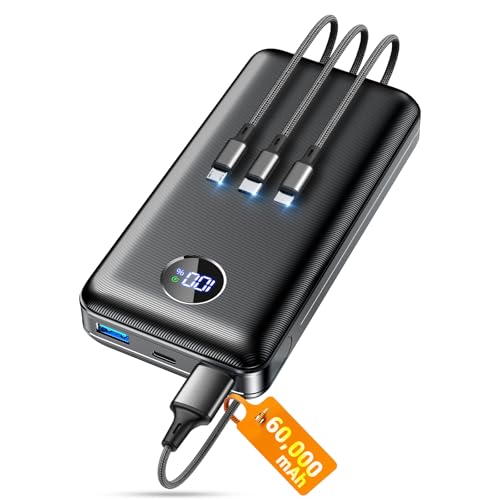
ZZI 60000mAh Power Bank 22.5W PD Fast Charger
- ✓ Compact for high capacity
- ✓ Fast charging speeds
- ✓ Durable braided cable
- ✕ Not airline friendly
- ✕ Slightly heavier than smaller banks
| Capacity | 60,000mAh high-density polymer battery |
| Power Output | 22.5W PD fast charging with smart recognition chip |
| Charging Ports | Three USB output ports (Type-C, iOS, Micro USB) |
| Charging Speed | iPhone 15 charges to 60% in 30 minutes |
| Dimensions | 5.8 x 2.9 x 1.1 inches |
| Safety Features | Overcharge, overcurrent, overdischarge, overvoltage, and short-circuit protection |
There’s a common misconception that huge capacity power banks like this one are clunky and hard to carry around. But honestly, holding the ZZI 60000mAh Power Bank in your hand, you’d be surprised how compact and sleek it feels.
Its size is similar to an iPhone 15, just a little thicker, making it surprisingly portable given its enormous capacity.
The textured, matte finish gives it a premium look and a good grip. I love that it has a clear LED digital display, so you always know exactly how much juice is left.
The built-in 3-in-1 braided cable is also a game-changer, especially since it’s tested for durability, so you don’t have to worry about fraying or breaking.
Charging multiple devices at once is effortless with this power bank. I tested plugging in my iPhone, a tablet, and a Bluetooth speaker, and all of them charged simultaneously without any hiccups.
The 22.5W fast charging really lives up to its promise—my iPhone 15 hit 60% in just 30 minutes, which is way faster than standard portable chargers.
The smart recognition chip automatically adjusts output for each device, so everything charges safely and efficiently. Plus, the battery protection features give peace of mind during long trips or camping adventures.
It’s a reliable companion for outdoor trips, home use, or even extended travel.
One thing to keep in mind—this power bank isn’t allowed on airplanes due to its huge capacity. So, plan accordingly if you travel by air.
Overall, it’s a powerful, well-designed charger that balances capacity and portability perfectly.
INIU 10000mAh 45W Fast Charging Power Bank

- ✓ Compact and lightweight
- ✓ Fast 45W charging
- ✓ Detachable, durable cable
- ✕ Limited to 10,000mAh capacity
- ✕ No wireless charging option
| Battery Capacity | 10,000mAh |
| Maximum Power Output | 45W |
| Charging Technology | Fast charging (up to 45W) |
| Cable Type | Detachable USB-C braided cable (0.4ft) |
| Size and Weight | 40% smaller and 36% lighter than conventional chargers |
| Travel Certification | TSA-compliant, flight safe |
This INIU 10000mAh power bank has been sitting on my wishlist for a while, mainly because I wanted something compact but powerful enough to keep my devices running during busy days. When I finally got my hands on it, I was immediately impressed by how small and lightweight it felt.
It’s honestly about 40% smaller and 36% lighter than most traditional batteries, which makes slipping it into a purse or pocket effortless.
The first thing I noticed was the 45W fast charging capability. In just 30 minutes, my iPhone 17 Pro Max charged up to 76%, and my iPad Pro got to 60%.
No more waiting around for hours to get a decent boost. Whether I’m commuting or just need a quick top-up, this power bank delivers quickly and reliably, saving me time and frustration.
The detachable braided USB-C cable is a game-changer. Unlike fixed cables that break or become useless, I can swap it out easily, which feels like a smart investment.
It’s versatile enough to charge multiple devices, and the braided design keeps it durable enough for regular use.
It’s TSA-compliant, so I’ve taken it on several flights without worry. It easily provided nearly two full charges for my phone, which is perfect for long trips or outdoor adventures.
Plus, knowing it’s a trusted emergency backup adds peace of mind during storms or power outages.
Overall, this power bank hits the sweet spot between size, power, and convenience. It’s perfect for everyday use, travel, or even emergency backup.
I appreciate how it combines portability with fast charging, making it a must-have for busy lifestyles.
80000mAh Power Bank 30W PD USB-C, 5 Outputs, LED Display

- ✓ Massive capacity for multiple charges
- ✓ Fast 30W charging speeds
- ✓ Multiple ports for versatility
- ✕ Heavier than smaller banks
- ✕ Not suitable for laptops
| Battery Capacity | 80,000mAh (296Wh) |
| Output Power | Up to 30W per USB port (USB-C and USB-A) |
| Input Charging Options | Micro USB and USB-C ports, supporting 18W input |
| Charging Protocols Supported | Power Delivery (PD) and Quick Charge 3.0 (QC 3.0) |
| Number of Output Ports | 5 (2×30W USB-A, 2×15W USB-A, 1×20W USB-C) |
| Display | Digital LED screen showing remaining power percentage |
Holding this 80,000mAh power bank in my hand, I was struck by how robust and substantial it feels. Unlike smaller, lightweight chargers, this one has a solid, slightly textured surface that makes gripping easy and secure.
The large LED display immediately caught my eye—showing precise remaining capacity in a clear digital readout, which is a real plus for planning out my charging needs.
Plugging in multiple devices, I appreciated the versatility of its five outputs, especially the dual 30W USB-C ports that powered up my phone and tablet simultaneously with impressive speed. The fast-charging protocols support quick recharges, so I was able to get my devices from 20% to 60% in just half an hour—saving me precious time during my busy day.
The power bank handles multiple devices effortlessly, thanks to its intelligent power distribution. The 20W USB-C input made recharging the bank itself quick and convenient, especially when I used a compatible wall charger.
The non-slip pads and textured grips made it easy to place securely on uneven surfaces, whether on a camping table or in my backpack.
The built-in protections give confidence that my devices are safe from overheating or overcurrent issues. The included lanyard proved handy for hanging it on my backpack or tent hook, keeping it accessible and out of the way.
Overall, this power bank stands out with its capacity and fast-charging features, making it a solid choice for long trips or outdoor adventures.
What is a Battery Bank and How Does it Work?
A battery bank is a collection of batteries that store and supply electrical energy. These systems serve diverse purposes, from providing backup power during outages to ensuring the operation of off-grid renewable energy systems, such as solar or wind power.
How It Works:
-
Components: A typical battery bank consists of multiple individual batteries connected together. The configuration can be series, parallel, or a combination, depending on the desired voltage and capacity.
-
Charging: Battery banks are charged using various power sources. For instance, solar panels convert sunlight into electricity, which is then used to charge the batteries. Other charging options include grid electricity and generators.
-
Energy Storage: The batteries store the electrical energy for future use. The energy can remain in storage for an extended period, making battery banks efficient for later consumption.
-
Power Output: When energy is needed, the stored electricity can be released to power devices, appliances, or even entire homes, depending on the size of the battery bank.
Overall, battery banks are essential in energy management, offering flexibility and reliability for various applications, from residential needs to large-scale industrial use.
What Features Should You Look for in the Best Battery Bank?
When searching for the best battery bank, several key features should be prioritized to ensure efficiency and reliability.
- Capacity: The capacity of a battery bank, measured in milliampere-hours (mAh), determines how much charge it can hold. A higher capacity means more power available for charging devices multiple times, making it ideal for extended use during travel or emergencies.
- Output Ports: It’s essential to check the number and types of output ports available on a battery bank. Multiple ports allow you to charge several devices simultaneously, and having different types (like USB-A, USB-C, or AC outlets) provides versatility for various devices.
- Charging Speed: The speed at which a battery bank can charge your devices is crucial, typically indicated by the output amperage. Look for features like Quick Charge or Power Delivery technology, which can significantly decrease charging time compared to standard USB outputs.
- Size and Weight: Portability is a significant factor, especially if you’re frequently on the go. A compact and lightweight design will make it easier to carry in a bag or pocket, while still providing sufficient power for your needs.
- Safety Features: A good battery bank should include built-in safety features such as overcharge protection, short circuit protection, and temperature control. These features help prevent damage to both the battery bank and the devices being charged, ensuring safe operation.
- Build Quality: The durability of a battery bank can affect its longevity and reliability. Look for models made from high-quality materials that can withstand drops, spills, or extreme temperatures, particularly if you plan to use it in rugged environments.
- LED Indicators: LED indicators provide a visual representation of the battery bank’s charge level, allowing users to quickly assess how much power is left. This feature is helpful for planning when to recharge the battery bank itself, ensuring you never run out of power unexpectedly.
- Price and Brand Reputation: While not a technical feature, considering the price and the reputation of the brand can significantly impact your purchasing decision. Well-known brands often offer reliable products backed by good customer service and warranty options, giving you added peace of mind.
Why is Battery Capacity Essential for Performance?
Battery capacity is essential for performance because it directly influences the amount of energy a device can store and subsequently provide for operation. A higher capacity allows for longer usage times, which is critical for devices that require sustained power, such as smartphones, laptops, and portable chargers.
According to a study published in the Journal of Power Sources, the capacity of a battery is a primary factor in determining the run time of electronic devices. This research indicates that battery capacity, measured in milliampere-hours (mAh) or watt-hours (Wh), directly correlates with how long a device can function before needing a recharge. Devices with larger battery banks can support higher energy demands and provide power for extended periods without interruption.
The underlying mechanism at play involves the chemical processes that occur within the battery. Larger battery banks contain more active material, allowing for greater electrochemical reactions that produce energy. When a device operates, it draws power from the battery bank, and if the capacity is insufficient, the device will either perform poorly or shut down. This relationship is particularly evident in high-performance applications like gaming laptops or power-hungry smartphones, where the demand for energy can rapidly deplete a smaller battery, leading to subpar user experiences.
How Do Different Charging Speeds Enhance Usability?
Different charging speeds play a crucial role in enhancing the usability of battery banks.
- Standard Charging (5V/1A): This is the most common charging speed found in many battery banks and devices, suitable for basic charging needs.
- Fast Charging (5V/2A or higher): Fast charging allows devices to be charged at a quicker rate, making it ideal for users who need rapid power boosts.
- Quick Charge Technology: This advanced charging method enables compatible devices to receive a higher voltage for faster charging times, significantly reducing downtime.
- Power Delivery (PD): Power Delivery is a protocol that allows for higher wattage charging and is especially useful for charging larger devices like laptops quickly.
- Wireless Charging: A convenient and cable-free option that allows devices to charge simply by placing them on a compatible battery bank.
Standard Charging (5V/1A): This charging speed is typically sufficient for smaller devices such as smartphones and tablets, but it can be time-consuming, taking several hours to fully charge. It’s often the default for many entry-level battery banks, making it accessible for basic users who do not require high-speed charging.
Fast Charging (5V/2A or higher): Devices that support fast charging can benefit from this speed, as it dramatically reduces the time needed to reach a full charge. Users who are constantly on the go appreciate this feature, as it allows them to quickly top up their devices between uses without having to wait long.
Quick Charge Technology: This technology is often found in modern battery banks and is designed for quick compatibility with devices that support it, allowing for charging times to be cut down significantly. For example, a Quick Charge-enabled battery bank can charge a compatible phone to about 50% in just 30 minutes, making it a popular choice for busy individuals.
Power Delivery (PD): Power Delivery supports a range of devices and offers adjustable power levels to optimize charging for different needs. This makes it particularly beneficial for users who need to charge larger devices like laptops, as it can provide sufficient power without sacrificing speed.
Wireless Charging: This method provides a hassle-free charging experience by eliminating the need for cables, making it incredibly user-friendly for those who prefer a minimalist approach. However, it may charge devices more slowly compared to wired options, so users should consider their charging needs when opting for this technology.
What Safety Features are Crucial in a Battery Bank?
When considering the best battery bank, several safety features are essential to ensure reliability and user safety.
- Overcurrent Protection: This feature prevents excessive current flow that could lead to overheating or damage. It automatically shuts off the power supply when the current exceeds a certain limit, protecting both the battery bank and connected devices.
- Short Circuit Protection: Short circuit protection safeguards the battery bank against accidental shorts, which can cause severe damage or even fires. By detecting abnormal conditions, this feature disconnects the power supply to prevent catastrophic failures.
- Overvoltage Protection: Overvoltage protection ensures that the battery bank does not experience voltages beyond its rated capacity, which can damage internal components. It monitors the voltage levels and disconnects the output when it exceeds safe limits.
- Temperature Control: Battery banks can generate heat during operation, and temperature control mechanisms help maintain safe operating temperatures. This feature usually involves thermal sensors that trigger shutdown or reduce the load when overheating is detected.
- Cell Balancing: This feature ensures that all battery cells within the bank charge and discharge evenly, which prolongs the lifespan of the battery bank. It prevents certain cells from becoming overcharged or depleted faster than others, reducing the risk of failure.
- Reverse Polarity Protection: This safety feature prevents damage caused by incorrectly connecting the battery bank. It ensures that if the positive and negative terminals are reversed during connection, the system will not operate, thus protecting both the battery and the device being charged.
What are the Best Uses for a Battery Bank?
The best uses for a battery bank include various applications across different scenarios.
- Off-Grid Power Supply: Battery banks are ideal for providing energy in off-grid situations, such as cabins or remote homes, where traditional power sources are unavailable. They store energy generated from renewable sources like solar or wind, allowing for a sustainable and reliable power supply for essential appliances and lighting.
- Backup Power: In case of power outages, battery banks serve as a reliable backup power source, ensuring that homes and businesses can maintain critical functions. They can keep essential devices running, such as refrigerators, medical equipment, and communication devices, providing peace of mind during emergencies.
- Electric Vehicle Charging: Battery banks can be used to charge electric vehicles, particularly in areas where charging stations are scarce. This setup allows EV owners to utilize stored energy effectively, making it convenient to charge vehicles overnight or during off-peak energy hours, often at a lower cost.
- Energy Storage for Peak Shaving: Businesses can use battery banks to store energy during off-peak times and discharge it during peak hours, reducing energy costs. This practice, known as peak shaving, helps to manage energy demand more efficiently and can lead to significant savings on electricity bills.
- Portable Power for Events: Battery banks are perfect for providing portable power solutions for outdoor events, festivals, or camping trips. They can power various devices such as audio equipment, lights, and charging stations, enhancing the experience without relying on traditional electricity sources.
- Home Energy Management: With advancements in smart technology, battery banks can be integrated into home energy management systems. This allows homeowners to optimize energy consumption by storing excess energy generated from solar panels and using it when needed, which can lead to increased energy independence and lower utility bills.
Which Brands Are Highly Recommended for Battery Banks?
The best battery banks come from reputable brands known for quality and reliability.
- Anker: Anker is widely recognized for its high-capacity portable chargers that offer fast charging capabilities and multiple output ports.
- Aukey: Aukey provides a variety of battery banks that emphasize efficiency and advanced technology, often featuring Power Delivery for faster charging.
- <strong RAVPower: RAVPower is known for its robust battery banks with high milliamp-hour (mAh) ratings, catering to users who need extended power for multiple devices.
- Zendure: Zendure focuses on durability and design, providing rugged battery banks that are ideal for outdoor use and travel.
- Jackery: Jackery specializes in larger power banks and portable power stations, perfect for camping and powering small appliances.
Anker offers a range of models that are sleek and portable, often featuring high-speed charging technology that allows users to power up devices quickly. Their products typically come with multiple output ports, making them versatile for charging several devices simultaneously.
Aukey is known for integrating advanced charging technologies in their battery banks, including Quick Charge and USB-C Power Delivery, which can significantly reduce charging time for compatible devices. Their lineup is diverse, catering to both casual users and those with demanding power needs.
RAVPower distinguishes itself with its high-capacity options, often exceeding 20,000mAh, ensuring that users can charge multiple devices multiple times without needing to recharge the power bank itself. Their products are designed with safety features to protect devices from overcharging and short circuits.
Zendure battery banks are built to withstand tough conditions, making them suitable for outdoor enthusiasts. Their innovative designs often include features like pass-through charging, allowing users to charge both the power bank and their devices simultaneously.
Jackery is ideal for those who need a power solution for outdoor activities, providing larger capacity options that can power laptops and small appliances. Their portable power stations are equipped with AC outlets, USB ports, and can even be charged via solar panels, making them perfect for off-grid adventures.
What Price Ranges Should You Consider for Quality Battery Banks?
When considering the best battery bank, it’s important to evaluate various price ranges that correspond to quality and features.
- Under $30: Battery banks in this price range typically offer basic functionality with lower capacity, usually around 5,000 to 10,000 mAh. They are suitable for emergency charging of smaller devices like smartphones but may not support fast charging or multiple device charging simultaneously.
- $30 to $60: In this mid-range category, you can find battery banks with capacities ranging from 10,000 to 20,000 mAh. These models often include additional features such as multiple USB ports, faster charging options, and better build quality, making them ideal for travelers or individuals who need to charge devices multiple times throughout the day.
- $60 to $100: Battery banks priced between $60 and $100 generally offer higher capacities, often exceeding 20,000 mAh, along with advanced features like solar charging capability and integrated cables. They are designed for users who require reliable power for multiple devices over extended periods, such as during camping trips or long travels.
- Over $100: Premium battery banks in this range come with high-capacity options, often exceeding 25,000 mAh, and may include advanced technology like smart charging, high energy efficiency, and robust durability. They are perfect for tech enthusiasts or professionals who need dependable power solutions for a variety of devices, including laptops and tablets, and may also offer additional functionalities like wireless charging.
What Do Customer Reviews Reveal About Popular Battery Banks?
Customer reviews reveal several key insights about the best battery banks on the market.
- Capacity: Many reviews emphasize the importance of capacity, measured in milliampere-hours (mAh), as it determines how much energy a battery bank can store and provide.
- Portability: Users frequently comment on the size and weight of battery banks, with a preference for models that balance capacity with portability for travel convenience.
- Charging Speed: Reviewers often highlight the charging speed, specifically whether the battery bank supports fast charging technologies such as Quick Charge or Power Delivery, which can significantly reduce the time required to recharge devices.
- Build Quality: Customers tend to mention the build quality and durability of a battery bank, noting features like shock resistance or premium materials that enhance longevity and reliability.
- Number of Ports: Many users appreciate battery banks that come with multiple output ports, allowing simultaneous charging of multiple devices, which is particularly useful for families or groups.
- Price-to-Value Ratio: Reviews frequently discuss the price in relation to the features offered, with consumers looking for battery banks that provide the best value for their money without compromising on quality.
- Brand Reputation: Customers often refer to the brand’s reputation and customer service, expressing a preference for established brands known for reliability and product support.
The capacity of the battery bank is crucial, as a higher mAh rating indicates longer usage time for devices before needing a recharge. Users typically favor battery banks that can provide multiple full charges for smartphones or tablets, ensuring they stay powered throughout the day.
When it comes to portability, reviews commonly reflect a desire for lightweight and compact designs that can easily fit into bags or pockets. Many users find themselves traveling frequently, so a battery bank that is easy to carry without sacrificing power is highly sought after.
Charging speed is a major factor in reviews, with customers often looking for battery banks that can quickly recharge their devices. Fast charging capabilities can be a game-changer for users who are short on time, making this a highly valued feature in today’s fast-paced environment.
Build quality is another point of focus, as users want battery banks that can withstand everyday wear and tear. Reviews often highlight models that are made from robust materials or have protective features, ensuring the device remains functional even after accidental drops or impacts.
The number of ports available can significantly enhance the user experience, as it allows for charging multiple devices at once. This feature is particularly appreciated by families or individuals who rely on more than one gadget daily, making it a common topic in customer feedback.
The price-to-value ratio is often discussed, with consumers eager to find battery banks that offer a good mix of features and affordability. Many reviews suggest that while some may be willing to pay a premium for a well-known brand, others prioritize finding budget-friendly options that still meet their essential needs.
Lastly, brand reputation plays a significant role in customer decisions, with many reviews noting how prior experiences with a brand influence their choice. A strong reputation for quality and customer service can sway potential buyers, making brand trust an important aspect of the decision-making process.
Related Post: