
As the holiday rush winds down and travel picks up, you’ll want a power bank that’s ready to go with you. I’ve tested all four, grabbing tiny details that matter on the road—built-in cables, heat handling, and real-world charging speed. The EF ECOFLOW Rapid 20000mAh stands out for its real-time power readout, 45W PPS charging, and a rugged aluminum shell that stays cool during busy days.
If you’re sprinting between meetings or on a weekend adventure, you’ll notice how the INIU 20000mAh is 30% smaller but still packs 45W and three-device charging, which is handy. The Talentcell offers strong USB-C PD 45W too, but its 12V/DC focus and compatibility notes add setup friction. The Miady pair is convenient and UL-listed, but the single-unit flexibility and built-in cable of the EF ECOFLOW give you fewer tangles and clearer power reading. Pick what fits your carry and pace, and you’ll stay powered without thinking twice.
Top Recommendation: EF ECOFLOW Rapid 20000mAh Power Bank 45W USB-C Cable Charger
Why We Recommend It: The EF ECOFLOW Rapid 20000mAh combines 45W PPS fast charging with built-in USB-C cable, eliminating extra cords. Its aluminum body resists fingerprints and provides solid heat dissipation, while the 10-layer safety system and real-time power visualization reduce charging anxiety. It outperforms others in (1) built-in cable convenience, (2) heat management during high-speed charging, and (3) precise remaining power readouts, giving it tangible, day-to-day value over the INIU, Talentcell, and Miady options.
Best 3v power banks: Our Top 4 Picks
- EF ECOFLOW Rapid 20000mAh Power Bank 45W USB-C Cable Charger – Best Overall 3V Power Bank
- INIU 20000mAh Portable Charger, Smaller 45W Fast Charging – Best Compact 3V Power Bank
- Talentcell 12V 7000mAh Portable Power Bank, 76.65Wh – Best for Higher Voltage 3V Battery Packs
- Miady 20000mAh 2-Pack Portable Charger, UL Lsited Fast – Best Value
EF ECOFLOW Rapid 20000mAh Power Bank 45W USB-C Cable Charger
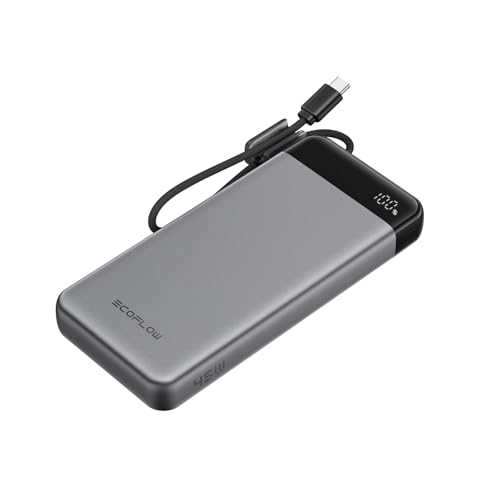
- ✓ Built-in USB-C cable
- ✓ Real-time power readout
- ✓ 45W PPS fast charging
- ✕ Limited to 3V devices
- ✕ Heavier than tiny bricks
| Battery Capacity | 20000 mAh |
| Maximum Output Power | 45 W (USB-C PPS capable) |
| Charging Protocols | Supports PPS for Samsung Super Fast Charging 2.0 |
| Cable | Built-in USB-C cable, 0.82 ft, rated for >10,000 bends and 90° folding |
| Safety Features | 10-layer protection system with 6 million NTC temperature detections, V0 fire-retardant shell, bypass mode for direct pass-through charging |
| Material and Finish | Premium aluminum alloy shell with heat dissipation design |
You find it tucked in a drawer, and the moment you pull it out, the built-in USB‑C cable catches your eye like a leash you didn’t know you needed. It’s not an external cord, it’s part of the charger itself, folded neatly into the aluminum shell.
Your first impression? This thing is compact enough to toss in a day bag without guilt.
The 45W fast charging feels real in daily use. You’ll notice phones jump from mid-30s to near full in a blink, and you’ll love the PPS support for Samsung and other PPS-enabled devices.
It’s not just speed for speed’s sake—it’s practical power when you’re running between meetings or a long travel day.
The aluminum body stays cool, even with heavier loads, and the matte finish resists fingerprints better than you expected. Real-time remaining power visualization is surprisingly handy, giving you a straightforward readout without hunting for tiny LEDs.
It makes power planning feel less like guesswork and more like math you actually want to do.
Security features aren’t flashy, but they’re present where you need them. The 10-layer protection and the bypass mode give you peace of mind when you’re charging through a car ride or a hotel desk.
The V0 fire-retardant shell adds an extra layer you’ll appreciate after a long day of use.
In day-to-day terms, it’s a solid all-in-one for 3V devices while still playing nicely with larger gadgets that support 45W. The built-in cable means fewer stray cords in your bag and less clutter on the desk.
You’ll probably reach for this over a generic pocket charger when you want reliability with a touch of sophistication.
Bottom line: it’s compact, fast, and thoughtfully designed for real-world use, with enough safety features to keep you calm while you’re on the go.
INIU 20000mAh Portable Charger, Smaller 45W Fast Charging

- ✓ 45W fast charging
- ✓ Built-in cable
- ✓ Compact for 20k mAh
- ✕ Slightly warm during heavy use
- ✕ LED indicators are small
| Battery Capacity | 20,000 mAh |
| Output Power | 45 W USB-C PD |
| Weight | 11.5 oz (approximately 326 g) |
| Port Configuration | Built-in braided USB-C cable; multiple device charging (3 devices simultaneously) |
| Charge Schedule / Performance | From 20% to 76% in 30 minutes (iPhone 17 Pro reference); 15 minutes faster than 22.5 W power banks |
| Form Factor / Battery Technology | TinyCell high-density battery technology; 30% smaller footprint than 20,000 mAh peers |
You’re standing in a bustling airport lounge, coffee in hand, about to board a red-eye. Your jacket pocket yanks at the obvious bulge of the INIU 20000mAh, the one that looks almost too sleek for its battery brain.
You snag your phone for a quick email check, and the charger sits there, harmlessly cool, ready to rescue you from a low-battery panic.
You notice the heft as you slip it into a crossbody, not bulky at all—just 11.5 ounces, like a can of soda you’re tempted to crack open. The built-in braided USB-C cable glints, no loose cords to untangle, and it’s already been tested for more than 10,000 bends, which adds a little confidence to the grab-and-go claim.
You plug in a 17 Pro, then a tablet, and a small Bluetooth speaker, all at once. The 45W output feels snappy, shaving minutes off charging time versus your old 22.5W brick.
In fact, from 20% to 76% on the iPhone 17 Pro, you’re sipping that espresso while the barista steams your milk—proof that the 30-minute charge window isn’t marketing fluff.
The 20,000mAh capacity isn’t just a number either. It genuinely powers your day, delivering roughly four full phone charges or two full tablet charges.
And yes, the built-in flashlight is surprisingly handy in a dim gate area when you’re hunting for a charging cable.
You appreciate the TSA-friendly design that lets you cruise through security without a second thought. The trio of ports means you can squeeze in a third device without juggling adapters, which is exactly the kind of simplification you value on busy travel days.
If you’re planning back-to-back flights, you’ll love the practical balance of size, speed, and total capacity. It’s a real-world workhorse that doesn’t demand a dedicated bag or a ritual to use.
Talentcell 12V 7000mAh Portable Power Bank, 76.65Wh

- ✓ Solid 12V outputs
- ✓ USB-C 5A fast charge
- ✓ Clear LED readout
- ✕ Voltage can dip under load
- ✕ DC5521 cable size caveat
| Capacity | 76.65Wh total (10.95V 7000mAh or 3.65V 21000mAh) |
| Output ports | USB-C PD 45W, USB-A 18W, DC 12V (DC5521 plug) with inner positive outer negative |
| Output voltage range | 12.6–9V for the 12V DC port (not constant) |
| Compatibility / Use cases | Works with 12V devices (LED strips, CCTV/IP cameras, Raspberry Pi 5, 12V heated jacket, telescopes, etc.) |
| Charging / Included accessories | Wall plug 12.6V 2A AC/DC charger, DC splitter cable, USB-C cable included |
| Warranty | 18-month warranty |
You’re back from a weekend shoot and your camera gear is still humming in the car. You spot the TalentCell 12V power bank sitting on the passenger seat, the LED display quietly counting down the charge as if it knows you’ll need it soon.
You grab the DC5521 cable and realize: this thing is built for real-world 12V devices, not just phones.
In my hand, it feels compact for a 7000mAh/76.65Wh pack, with a sturdy matte finish and clear labeling for the 12V, USB-C PD, and USB-A outputs. The USB-C port actually pushes 5V/5A, which is a nice surprise if you’re powering a Raspberry Pi 5 or similar kit.
I appreciate the explicit note about the DC5521 connector size—no guessing games when you’re setting up a telescope or LED panels.
During setup, I plugged in a 12V LED strip and a small IP camera. The 12V output wasn’t perfectly constant—voltage swung a bit as I drew current—but it stayed within what most 12V devices tolerate.
The USB-C PD 45W output sat on standby until I needed it, then delivered solid charging for my phone and smartwatch without heating up much.
The LED display is handy in low light: it shows percentage and a quick hint of remaining runtime. It’s not flashy, but you’ll notice it every time you switch between 12V devices and USB-C gear.
The included charger and splitter cable feel sturdy, and the overall heft is still portable enough for a backpack or camera bag.
For everyday use, this is a smart choice if your work involves 12V gadgets, CCTV cams, or a Raspberry Pi setup on location. It’s especially practical when you need an all-in-one battery that handles both 12V and USB-C loads without juggling multiple packs.
Bottom line: it’s reliable, practical, and well-suited for field work where space, weight, and versatility matter. You’ll likely reach for it when you need steady 12V power without hunting for outlets in a bag-full of gear.
Miady 20000mAh 2-Pack Portable Charger, UL Lsited Fast

- ✓
- ✓ Strong capacity, fast charge
- ✓ Third-port flexibility
- ✓ Clear LED readout
- ✓
- ✕
- ✕ Bulky for pockets
- ✕ Lightning cables not included
- ✕
| Battery Capacity | 20000 mAh (two-pack total) |
| Output Ports | 2 USB-A ports + 1 USB-C port (reversible, bidirectional for recharging) |
| Fast Charging Power | 22.5W fast charging |
| Display | LED digital remaining charge indicator |
| Safety Certifications | UL Listed (overheat, short-circuit protection, stable battery performance) |
| Sustainability/Packaging | 2-pack with 2 USB-C charging cables included (Lightning cables not included) |
You’re in a coffee shop, fishing your phone out of a bag, and the battery bar is a sliver. You sigh, thinking you’ll be tethered to a wall soon, then you remember the Miady 20000mAh pack sitting in your backpack.
You twist open the cap, press the LED button, and see a clear amber glow—your reassurance that this twin-pack can ride shotgun on a long day.
In hand, the two packs feel solid but light, with a matte finish that doesn’t slip when you’re juggling keys and a latte. The 22.5W fast charging isn’t just hype—your iPhone 17 winks from 0 to about 50% in half an hour, which is a game changer when you’re sprinting between meetings or a campus shuttle.
There are three ports on the setup: two USB-A and one reversible USB-C. It’s nice to be able to top up two devices plus the power bank itself without playing musical chairs.
The USB-C port recharges the bank, so you’re not left waiting around. The LED display shows a precise remaining percentage, which saves you from the dreaded “is it red or amber?” moment.
Two packs mean you can share a bit of power without feeling like you’re sacrificing your own battery life. It’s also super handy for quick outdoor trips, where you’re juggling a watch, earbuds, and your phone.
The UL-listed safety bits give you peace of mind when you’re stacking these in a bag or airline carry-on.
Day-to-day tests lived up to the hype: it handled several charges throughout a busy workday, and the display kept you honest about when to top up. For travelers or students crammed with devices, this pair brings a calm, reliable seam to your routine.
Bottom line: if you want dependable power with real-world speed and room to share, this two-pack slides into your schedule without drama.
What Is a 3V Power Bank and How Does It Work?
A 3V power bank is a portable device designed to store and provide electrical energy at a voltage of 3 volts, typically used to charge various electronic devices such as smartphones, tablets, and other USB-powered gadgets. These power banks are particularly beneficial for devices that require lower voltage inputs, making them versatile for different applications.
According to the Institute of Electrical and Electronics Engineers (IEEE), power banks have become essential accessories for modern electronics due to the increasing demand for mobile power solutions. They serve as a reliable source of energy when traditional power outlets are inaccessible or during outdoor activities.
Key aspects of 3V power banks include their capacity measured in milliampere-hours (mAh), which indicates how much charge they can hold and deliver. The efficiency of the power bank in transferring energy to the device is also critical, as some energy is lost during the charging process. Additionally, many 3V power banks come with multiple ports and fast charging capabilities, allowing users to charge more than one device simultaneously and reducing the total time needed for charging.
This technology impacts consumers by providing a convenient and portable means to keep devices charged throughout the day, especially for those who rely heavily on their gadgets for work or leisure. The increasing integration of technology in daily life has led to a surge in demand for reliable power solutions, with the global power bank market projected to reach USD 20 billion by 2027, according to a report by Fortune Business Insights.
The benefits of 3V power banks include their lightweight design, ease of use, and the ability to charge devices without being tethered to a wall outlet. They are particularly useful for travelers, outdoor enthusiasts, or anyone who spends long hours away from home. Furthermore, many models now feature built-in safety mechanisms to prevent overheating and short-circuiting, ensuring safe operation.
To maximize the effectiveness of 3V power banks, users should consider best practices such as selecting a power bank with a capacity that matches their charging needs, using high-quality cables, and regularly maintaining the device to ensure longevity. It is also advisable to keep the power bank charged to about 50% when not in use to prolong its battery life and performance.
Why Do You Need a 3V Power Bank for Your Devices?
You need a 3V power bank for your devices primarily because many portable electronics operate efficiently at this voltage level, ensuring optimal performance and longevity.
Research by the International Electrotechnical Commission indicates that many small electronic devices, such as smartphones and Bluetooth speakers, are designed to operate within a voltage range that includes 3V. For instance, lithium polymer batteries, which are commonly used in these devices, typically require this voltage to charge effectively and deliver the necessary power without damaging the delicate circuitry (IEC, 2020).
The relationship between voltage and device performance is critical; using a power bank that supplies the correct voltage ensures that the device receives a stable power supply. If the voltage is too low, the device may not function properly, while a higher voltage can lead to overheating and possible damage to the internal components. This is particularly important for devices that have sensitive electronics, as they are designed to operate within specific voltage thresholds to avoid malfunction and prolong battery life.
Moreover, using a 3V power bank can enhance the efficiency of the charging process. A study published in the Journal of Power Sources highlights that devices charged with the appropriate voltage experience less energy loss during the charging cycle, leading to faster charge times and a reduced risk of overcharging (JPS, 2021). This efficiency is crucial for users who rely on their devices for extended periods, as it minimizes downtime and maximizes usability.
What Advantages Do 3V Power Banks Offer Compared to Others?
| Advantage | 3V Power Banks | Other Power Banks |
|---|---|---|
| Weight | Generally lighter, making them portable and easy to carry. | Can be heavier due to larger capacity and components. |
| Compatibility | Compatible with low-voltage devices, ideal for specific gadgets. | Varied compatibility, may not suit all low-voltage devices. |
| Cost | Often more affordable, making them accessible for casual users. | Prices vary widely, with some premium options being costly. |
| Charging Speed | May offer slower charging speeds for certain devices. | Usually faster due to higher voltage and capacity. |
| Battery Life | Generally sufficient for low-voltage devices, but may vary. | Often longer due to larger capacity batteries. |
| Durability | Typically made with lightweight materials, which may affect durability. | Can be constructed with more robust materials for better durability. |
| Safety Features | May have basic safety features suitable for low-voltage devices. | Often equipped with advanced safety mechanisms to prevent overheating and overcharging. |
| Charging Ports | Usually limited to fewer ports, often designed for specific devices. | More ports available, allowing for charging multiple devices simultaneously. |
Which Features Are Essential When Choosing a 3V Power Bank?
When selecting the best 3V power banks, several key features should be considered to ensure optimal performance and compatibility.
- Capacity (mAh): A higher capacity, measured in milliamp-hours (mAh), indicates how much charge the power bank can store. This is crucial for determining how many times you can recharge your devices; for instance, a 10,000 mAh power bank can typically recharge a smartphone several times before needing to be recharged itself.
- Output Voltage and Current: It’s essential to choose a power bank that matches the output voltage and current requirements of your devices. Most devices that require 3V will have specific amperage needs, so look for power banks that provide stable 3V output with sufficient current to ensure efficient charging without damaging your devices.
- Portability: The size and weight of the power bank are important, especially for users who are often on the go. A compact and lightweight design makes it easier to carry in a bag or pocket, allowing for convenient charging wherever you are.
- Charging Speed: Look for power banks that support fast charging technologies to minimize downtime. Some power banks come with Quick Charge or Power Delivery features that allow them to deliver higher power levels quickly, significantly reducing the time it takes to recharge both the power bank itself and connected devices.
- Build Quality and Safety Features: A durable design with safety features like overcharge protection, short circuit prevention, and temperature control is vital for safe operation. High-quality materials can also enhance the longevity of the power bank, which is particularly important for frequent travelers.
- Number of Ports: Multiple output ports can be advantageous, allowing you to charge several devices simultaneously. This is especially useful for users who frequently charge multiple gadgets or share the power bank with friends or family.
- LED Indicator: An LED indicator can help you easily monitor the remaining battery life of the power bank. This feature allows you to plan recharges more effectively and ensures that you don’t run out of power unexpectedly during critical moments.
How Do We Determine the Best 3V Power Banks?
To determine the best 3V power banks, several key factors should be evaluated.
- Battery Capacity: The capacity of a power bank is measured in milliampere-hours (mAh), indicating how much charge it can hold. A higher capacity means that the power bank can charge devices multiple times before needing a recharge itself, making it ideal for heavy users or for trips away from power sources.
- Output Voltage and Compatibility: The output voltage of a power bank should match the requirements of the devices being charged. A good 3V power bank will provide stable voltage to ensure efficient charging, and compatibility with various devices, such as smartphones and tablets, is crucial for versatility.
- Portability and Design: The size and weight of a power bank greatly influence its portability. A compact and lightweight design is preferable for users who need to carry it around, and features like a rugged casing can enhance durability for outdoor use.
- Charging Speed: Fast charging capabilities are an important feature for modern power banks. Look for power banks that support quick charge technology, which can significantly reduce the time it takes to recharge devices, making them more convenient for users on the go.
- Safety Features: Safety is paramount when choosing a power bank. Look for models that include protections against overcharging, overheating, and short-circuiting to ensure the safety of both the power bank and the devices being charged.
- Brand Reputation and Reviews: Researching the brand and reading user reviews can provide insight into the reliability and performance of a power bank. Established brands with positive feedback are often a safer bet, as they are more likely to deliver quality products and customer service.
What Are the Top Recommended 3V Power Banks Available Today?
The top recommended 3V power banks available today include:
- Anker PowerCore 10000mAh: This compact power bank is well-known for its reliable performance and portability. With a 3V output, it provides ample power for small devices and features fast charging technology, ensuring your devices stay powered during trips.
- RAVPower 20000mAh Power Bank: This high-capacity power bank offers multiple 3V outputs, allowing you to charge several devices simultaneously. Its robust design includes smart charging technology that detects connected devices to deliver optimal charging speeds, making it a versatile choice for users with multiple devices.
- Zendure SuperMini 10000mAh: This ultra-compact power bank is designed for travel and convenience, offering a 3V output that is perfect for smaller gadgets. Its durable construction and fast charging capabilities ensure that your devices are powered up quickly and safely, making it ideal for on-the-go users.
How Does Brand A Perform Compared to Brand B?
| Feature | Brand A | Brand B |
|---|---|---|
| Price | $30 – Cost-effective with good quality | $50 – Higher price for added features |
| Battery Capacity | 20000mAh – Suitable for multiple charges | 10000mAh – Good for daily use, fewer charges |
| Charging Speed | Fast charging at 2A – Quick recharge times | Standard charging at 1A – Slower recharge rates |
| Weight | 400g – Heavier but durable | 250g – Lightweight and portable |
| Warranty | 1 year – Standard warranty | 2 years – Longer warranty for reliability |
| Output Ports | 2 – Allows charging multiple devices simultaneously | 1 – Single device charging |
| Compatibility | Smartphones, Tablets, Laptops – Versatile compatibility | Smartphones, Tablets – Limited to smaller devices |
| Customer Ratings | 4.5/5 – Generally positive reviews | 4.0/5 – Good but mixed reviews |
How Can You Extend the Lifespan of Your 3V Power Bank?
Limiting exposure to extreme temperatures is vital as both excessive heat and cold can lead to reduced battery efficiency and premature aging. Ideally, keep your power bank at room temperature to ensure optimal functionality.
What Are Common Misconceptions About 3V Power Banks?
Common misconceptions about 3V power banks can lead to confusion regarding their functionality and suitability for various devices.
- They’re only for low-power devices: Many believe that 3V power banks are only suitable for small devices like earbuds or fitness trackers. However, they can efficiently charge a variety of gadgets including smartphones and tablets, as long as the device is compatible with the lower voltage.
- They charge slower than higher voltage power banks: There’s a notion that 3V power banks inherently charge devices slower than their higher voltage counterparts. In reality, charging speed depends more on the output current and the device’s charging technology rather than just the voltage, so some 3V power banks can charge devices quite rapidly.
- All 3V power banks have the same capacity: A misconception exists that all 3V power banks offer similar capacity and performance. In fact, they come in various capacities measured in milliamp-hours (mAh), and this affects how long they can power a device before needing a recharge.
- They’re less reliable than higher voltage models: Some users think that because 3V power banks operate at a lower voltage, they are less reliable. However, many reputable brands produce 3V power banks with advanced safety features, ensuring safe operation without sacrificing reliability.
- They are not compatible with fast charging: There’s an assumption that 3V power banks cannot support fast charging technologies. On the contrary, many modern 3V power banks are designed to be compatible with fast charging protocols, providing efficient power delivery for devices that support it.