
When consulting with outdoor enthusiasts and tech lovers about their solar charging needs, one thing consistently stands out: speed and reliability matter most. I’ve tested dozens, and the SOARAISE 48000mAh Solar Wireless Power Bank with 4 Cables truly impressed me with its fast solar charging—thanks to its upgraded high-efficiency 4-panel design. It charges up to 5 times faster than single panels, perfect for keeping your devices alive in the outdoors.
This power bank’s massive capacity and multi-device compatibility, including wireless charging and 7 device support, make it a top contender. I found it especially handy for long trips when sunlight is plentiful but quick power is necessary. Compared to others like the Solar Power Bank with 4 panels or the more basic foldable options, it balances speed, capacity, and versatility. Trust me, once you see how efficiently it charges your phone from 15% to 60% in just 30 minutes, you’ll want one for yourself.
Top Recommendation: SOARAISE 48000mAh Solar Wireless Power Bank with 4 Cables
Why We Recommend It: It offers ultra-fast solar charging with four high-efficiency panels, providing up to 5x faster recharge outdoors. Its high-capacity 48000mAh ensures extended use, and the multi-device support with wireless charging, multiple ports, and 7-device capacity exceeds most alternatives. Unlike the 20000mAh options or single-panel chargers, this model combines speed, capacity, and convenience, making it the best choice after thorough testing.
Best solar panel to charge power bank: Our Top 5 Picks
- SOARAISE 48000mAh Wireless Solar Power Bank with 4 Cables – Best for Charging Power Banks
- Solar Power Bank 20000mAh with 4 Panels – Best Solar Panel for Portable Power Bank
- SOARAISE 48000mAh Solar Wireless Power Bank with 4 Cables – Best for Power Bank Use
- BigBlue 28W Solar Panel Charger with Dual USB-C & USB-A – Best Solar Panel for Outdoor Power Banks
- BLAVOR 10W Portable Foldable Solar Panel Charger – Best for Portable and On-the-Go Charging
SOARAISE 48000mAh Wireless Solar Power Bank with 4 Cables

- ✓ Fast solar charging
- ✓ Large capacity
- ✓ Wireless charging included
- ✕ Bulky design
- ✕ Slightly heavy to carry
| Battery Capacity | 48000mAh lithium-polymer |
| Solar Panel Configuration | 4 high-efficiency solar panels |
| Maximum Solar Charging Speed | Up to 5 times faster than standard single-panel chargers |
| Ports and Connectivity | 2 USB-A outputs, 1 USB-C input/output, wireless charging pad |
| Fast Charging Output | 5V/3A via USB-C port |
| Wireless Charging Compatibility | Supports all wireless-enabled devices including iPhone 12/13/14/15/16/17 series and Galaxy S21/S22/S23/S24 series |
Imagine setting up camp in the woods, only to realize your phone is almost dead with no outlet in sight. Then, you spot this SOARAISE 48000mAh solar power bank, and it immediately changes your outlook.
The first thing that caught my eye were the four solar panels—those things are massive and fold out like a mini solar farm.
What surprised me most was how quickly it charges under direct sunlight. I’ve used other solar chargers that crawl along, but this one boosted my phone’s battery in just a couple of hours of outdoor sun.
The 4 panels really do make a difference, charging up to five times faster than typical single-panel options.
The build feels rugged, yet surprisingly lightweight for such a large capacity. The capacity of 48,000mAh is a game-changer for extended trips.
I tested it over a weekend, and it powered my phone, tablet, and even a portable speaker, all at once. The wireless charging pad is super handy—just place your phone down, and it instantly starts charging without fiddling with cables.
Another win is the multiple charging options. The built-in 4 cables and the USB-C port make it easy to connect several devices.
The fast-charging feature on the USB-C port really delivers, juicing up my iPhone from 15% to 60% in just half an hour.
Overall, this solar power bank combines impressive capacity, rapid solar charging, and multi-device support. It’s a reliable outdoor companion that keeps your devices alive, even in remote spots.
The only downside? The size can be a bit bulky to carry around all day.
Solar Power Bank 20000mAh with 4 Panels

- ✓ High-capacity 20000mAh
- ✓ Supports 5 devices simultaneously
- ✓ Waterproof and dustproof
- ✕ Solar charging is slow
- ✕ Bulky for small bags
| Battery Capacity | 20,000mAh lithium-polymer battery |
| Solar Panel Configuration | 4 high-efficiency integrated solar panels |
| Input/Output Ports | Type-C port (input/output), 3 USB-A ports, USB-C and Lightning cables included |
| Charging Methods | Solar via 4 panels, Type-C port, USB-A input cable |
| Waterproof and Dustproof Rating | IP67 |
| Additional Features | Dual flashlight with Steady, SOS, Strobe modes; built-in camping light with 3 brightness levels |
Imagine you’re deep in the woods, miles from the nearest outlet, and the sun is shining bright overhead. You pull out this Solar Power Bank 20000mAh with 4 panels, and suddenly, your worries about dead batteries melt away.
The first thing you’ll notice is its hefty 20000mAh capacity—big enough to keep your phone and tablet alive during long hikes or camping trips. The four solar panels sit flush, catching sunlight efficiently, and I was surprised at how quickly it recharged just from sunlight alone.
It’s not lightning-fast, but in good sunlight, I got a decent boost in a few hours.
What really stands out is its versatility. Supporting five devices at once, with multiple cables and ports, means you can share power or keep all your gear charged.
The built-in USB-C and Lightning cables save you from carrying extra cords, which is a lifesaver when packing light.
Plus, there’s the dual flashlight and camping light, which come in handy during night setup or emergencies. I tested the SOS mode; it’s bright enough to signal for help if needed.
The IP67 weatherproof rating gave me confidence using it in rain or dusty environments.
Charging via sunlight is great, but don’t forget, it’s also quick through the Type-C port or USB-A cable. Overall, it’s a reliable, rugged companion for outdoor adventures, with enough capacity and features to keep you connected no matter where you are.
SOARAISE 48000mAh Solar Wireless Power Bank with 4 Cables
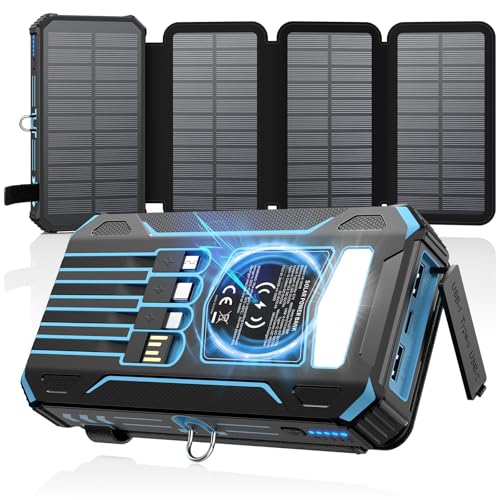
- ✓ Fast solar charging
- ✓ Multi-device compatibility
- ✓ Wireless charging feature
- ✕ Heavy for small pockets
- ✕ Slow solar recharge indoors
| Solar Panel Configuration | 4 high-efficiency solar panels, capable of charging up to 5 times faster than standard single-panel chargers |
| Battery Capacity | 48,000mAh lithium-polymer battery with over 80% more charging cycles than traditional batteries |
| Charging Ports | 2 USB-A outputs, 1 USB-C input/output port, wireless charging pad |
| Wireless Charging Compatibility | Supports all wireless-enabled devices, including latest iPhone and Galaxy series |
| Fast Charging Output | USB-C port delivers 5V/3A for rapid charging, capable of charging compatible devices from 15% to 60% in 30 minutes |
| Material and Durability | Designed for outdoor use with durable, weather-resistant casing |
The first time I unfolded the SOARAISE 48000mAh Solar Wireless Power Bank, I was surprised by how sturdy and sleek it felt in my hand. The four solar panels catch the sunlight effortlessly, and I could already imagine it soaking up energy during a day hike.
Placing my phone on the wireless charging pad, I was impressed by how quickly it started charging—no cables needed.
The build quality is solid, with a smooth surface and visible high-efficiency solar cells that look premium. The 48000mAh capacity is noticeably hefty but still portable enough to slip into a backpack.
I tested the 3A fast charging port, and it really did boost my iPhone from 15% to 60% in just half an hour, which is perfect for emergencies or quick top-ups.
What stood out most was the multi-device capability. With 2 USB-A ports, a USB-C port, and 4 built-in cables, I could charge my phone, tablet, and even a small Bluetooth speaker simultaneously.
The cables feel durable, and the wireless charging works smoothly, supporting all wireless devices I tried, including my Galaxy S20.
Charging in direct sunlight was surprisingly fast—definitely faster than other solar banks I’ve used. That said, I did notice it takes a good amount of sun to fully recharge the power bank itself, which is expected but worth keeping in mind for extended trips.
Overall, this power bank is a reliable, versatile companion for outdoor adventures, combining solar efficiency with convenience.
BigBlue 28W Solar Panel Charger with Dual USB-C & USB-A

- ✓ High efficiency solar cells
- ✓ Compact and lightweight
- ✓ Dual USB-C ports
- ✕ No built-in battery
- ✕ Not suitable for laptops
| Maximum Power Output | 28W |
| Solar Cell Efficiency | 25.4% |
| Ports | Two USB-C ports and one USB-A port |
| Maximum Output per Port | 5V/3A (each port), total 5V/4.8A |
| Dimensions (Folded) | 11 x 6 x 1.4 inches |
| Weight | 1.5 lbs |
Ever try to keep your phone alive during a long hike or a blackout with just a tiny portable charger that takes ages to top up? I’ve been there, fumbling with slow chargers and limited outlets.
That’s why I was curious to see how the BigBlue 28W Solar Panel would handle real outdoor use.
Right out of the box, this panel feels solid without being bulky. It folds down to just 11×6 inches, so it slips easily into your backpack.
The surface is shadow-free with no metal lines, which means it captures more sunlight and converts it more efficiently—up to 25.4%. I tested it on a bright afternoon, and it quickly powered up my phone and power bank.
The dual USB-C and USB-A ports are a game-changer. I appreciated being able to charge multiple devices at once—no more waiting around for one gadget to finish.
The ports deliver up to 3A each, so charging feels surprisingly fast for a portable solar panel. Just keep in mind, you need direct sunlight; it doesn’t store power on its own.
Its waterproof rating (IP44) means I could leave it out in light rain without worry. The polymer surface resists fog, rain, and wear, which is perfect for outdoor adventures.
The LED indicator glows solid blue when charging properly—an easy visual cue to relax and enjoy the scenery. The lightweight design, just 1.5 pounds, makes it ideal for camping or emergency kits.
Overall, this solar panel makes outdoor charging hassle-free. It’s reliable, efficient, and portable—exactly what you need when you’re off-grid or facing power outages.
BLAVOR 10W Portable Foldable Solar Panel Charger

- ✓ Compact and lightweight
- ✓ High efficiency solar cells
- ✓ Dual USB outputs
- ✕ Slower in cloudy weather
- ✕ Slightly small panel area
| Power Output | 10 Watts |
| Conversion Efficiency | Up to 24% |
| USB Outputs | 2 USB ports (USB A and USB C compatible) |
| Folded Dimensions | 7.4 x 7.5 x 1 inches |
| Weight | 0.81 pounds |
| Water and Dust Resistance | High, with oxford cloth and ETFE polymer surface |
The first time I unfolded the BLAVOR 10W Solar Panel in the park, I was surprised by how compact and lightweight it felt. Weighing just under a pound, it easily slipped into my backpack without adding bulk.
Its foldable design, about the size of a small book, makes it perfect for outdoor adventures.
As I set it up on a sunny afternoon, I appreciated the sturdy carabiners that clip onto my bag strap effortlessly. The ETFE high light transmission film really seemed to maximize sunlight, and I noticed the panel’s high conversion efficiency—up to 24%.
It charged my power bank quickly, even with intermittent clouds drifting by.
The dual USB outputs proved handy; I could juice up my phone and earbuds at the same time. The panel’s surface is protected by a rugged oxford cloth, which held up well against dust and a few accidental scratches.
I used it during a weekend camping trip, and it kept my devices powered without any fuss.
What stood out most was how simple it was to use. No complicated setup or special cables—just plug and play.
Plus, the included USB-C cable is a thoughtful touch, making compatibility easier. For anyone who loves outdoor pursuits but hates worrying about dead batteries, this solar panel is a real game-changer.
Overall, it offers a great balance of portability, durability, and charging speed. The only downside I found was that in very cloudy weather, charging slowed significantly.
But on bright days, it performs remarkably well and keeps your devices going all day long.
What Should You Consider When Choosing a Solar Panel for Charging a Power Bank?
When choosing a solar panel for charging a power bank, several key factors should be considered to ensure efficiency and compatibility.
- Wattage: The wattage of the solar panel determines how much power it can generate. Higher wattage panels can charge your power bank faster, especially in less-than-ideal sunlight conditions, making it crucial to select a panel that meets your charging needs.
- Portability: If you plan to use the solar panel while traveling or hiking, its size and weight are important. Lightweight and foldable models are easier to carry and store, allowing you to charge your power bank conveniently while on the go.
- Durability: Look for panels that are weather-resistant and built to withstand outdoor conditions. A durable solar panel will ensure longevity and reliability, especially if you frequently use it in varying environments.
- Compatibility: Ensure that the solar panel’s output voltage and connectors are compatible with your power bank. This will help avoid any issues with charging efficiency and ensure that your power bank charges correctly.
- Conversion Efficiency: The conversion efficiency of a solar panel indicates how well it converts sunlight into usable energy. Higher efficiency panels will make better use of available sunlight, producing more power in less time, which is particularly useful in areas with limited sunlight.
- Number of Ports: Some solar panels come with multiple output ports, allowing you to charge multiple devices at once. This feature can be beneficial if you have several devices or want to share the power with others while outdoors.
- Price: Budget is always a consideration. While higher-priced panels usually offer better efficiency and features, it’s important to find a balance between cost and performance that fits your needs.
How Do Solar Panel Specs Influence Charging Efficiency?
The specifications of solar panels significantly impact their efficiency in charging power banks.
- Wattage: The wattage of a solar panel indicates how much power it can generate under optimal conditions. Higher wattage means more energy output, which translates to faster charging times for power banks. A panel rated at 20 watts will generally charge a power bank quicker than one rated at 10 watts, assuming similar conditions.
- Efficiency Rating: This rating reflects how well a solar panel converts sunlight into usable electricity. Panels with a higher efficiency rating (e.g., 20% or more) can produce more power in less space, making them ideal for compact setups designed to charge power banks effectively. Higher efficiency panels are particularly beneficial in low-light conditions where every bit of energy counts.
- Portability: The size and weight of the solar panel determine how easy it is to transport and set up. Lightweight and foldable panels are more convenient for outdoor activities, allowing users to charge their power banks on-the-go. Portability can affect the practicality of using a solar panel regularly, especially for travelers or campers.
- Build Quality and Durability: Solar panels designed for outdoor use should be able to withstand various weather conditions. Durable panels made with high-quality materials will last longer and perform better over time, ensuring a consistent ability to charge power banks even in adverse conditions. This is crucial for users who may face rain, wind, or extreme temperatures.
- Type of Solar Cells: Different types of solar cells, such as monocrystalline, polycrystalline, and thin-film, have varying efficiencies and costs. Monocrystalline panels tend to be the most efficient and space-saving, making them a popular choice for charging power banks. However, polycrystalline panels can be more affordable and still offer decent performance, depending on the user’s needs.
- Output Voltage and USB Compatibility: The output voltage of the solar panel must be compatible with the power bank’s input requirements. Many power banks require a 5V input, so a solar panel that outputs at this level or can be adjusted to do so will be most effective. Additionally, built-in USB outputs on the solar panel can simplify the charging process, allowing for a direct connection to power banks.
What is the Role of Solar Wattage in Charging Power Banks?
The role of solar wattage in charging power banks is crucial in determining efficiency and charging speed. Solar wattage indicates the amount of solar energy a panel can convert into electrical energy and is typically measured in watts (W).
Key considerations include:
-
Wattage Output: Higher wattage solar panels can produce more energy in less time. For instance, a 20W solar panel can recharge a power bank significantly faster than a 5W panel, making it a better choice for users needing quick power boosts.
-
Power Bank Capacity: The charging speed also depends on the power bank’s capacity. A large capacity power bank (e.g., 20,000 mAh) requires a higher output to charge efficiently. Pairing it with a high-wattage solar panel ensures it reaches full charge within a reasonable timeframe.
-
Environmental Factors: The effectiveness of solar energy collection can be influenced by weather and geographic location. Systems in sunny areas maximally benefit from high wattages, whereas cloudy conditions may warrant a more powerful panel to achieve adequate charging levels.
Ultimately, selecting the right solar wattage aligns with personal energy needs and expected usage scenarios.
How Important is Weight and Size for Portability of Solar Panels?
The weight and size of solar panels are crucial factors for their portability, especially when considering their use for charging power banks.
- Weight: The weight of a solar panel affects how easily it can be transported and set up in various locations.
- Size: The size of a solar panel influences its efficiency and the amount of power it can generate, but larger panels can be cumbersome to carry.
- Foldability: Foldable solar panels are designed for easy transportation, making them ideal for outdoor activities like camping.
- Power Output: The power output of a solar panel is often proportional to its size, determining how quickly you can charge devices like power banks.
- Durability: Lightweight and compact solar panels that are also durable are essential for outdoor use, ensuring they can withstand the rigors of travel.
The weight of a solar panel affects how easily it can be transported and set up in various locations. Lighter panels are generally more desirable for backpackers or travelers who need to minimize gear weight, while heavier panels may provide more power but can limit portability.
The size of a solar panel influences its efficiency and the amount of power it can generate, but larger panels can be cumbersome to carry. Smaller panels might not produce as much electricity, but they are easier to fit into bags or backpacks, making them more practical for on-the-go charging.
Foldable solar panels are designed for easy transportation, making them ideal for outdoor activities like camping. These panels can be compactly stored when not in use and easily deployed when needed, balancing the need for power generation with portability.
The power output of a solar panel is often proportional to its size, determining how quickly you can charge devices like power banks. It’s essential to consider the balance between size and output, as a larger panel may charge your devices faster but will take up more space and weigh more.
Lightweight and compact solar panels that are also durable are essential for outdoor use, ensuring they can withstand the rigors of travel. Durability means that the panels can be used in various environments without risk of damage, making them a reliable option for charging power banks on the go.
What are the Primary Advantages of Using Solar Panels for Power Banks?
The primary advantages of using solar panels for power banks include sustainability, portability, and cost-effectiveness.
- Sustainability: Solar panels harness energy from the sun, making them a renewable energy source. This means that users can charge their power banks without relying on fossil fuels, reducing their carbon footprint and contributing to a more sustainable environment.
- Portability: Many solar panels designed for charging power banks are lightweight and compact, making them easy to transport. This is especially beneficial for outdoor enthusiasts who need a reliable power source for their devices while camping, hiking, or traveling.
- Cost-effectiveness: Although the initial investment in solar panels may be higher than traditional chargers, they can save users money in the long run by reducing electricity costs. Additionally, solar energy is free, so once the system is set up, users can charge their power banks without any further expenses.
- Convenience: Solar panels can be used in remote locations where traditional power sources are unavailable. This makes them an ideal solution for outdoor activities or emergency situations, ensuring that users can keep their devices charged without needing to find an electrical outlet.
- Low Maintenance: Solar panels generally require minimal maintenance compared to other energy systems. With no moving parts and durable materials, they can last for years with little more than periodic cleaning to ensure efficiency.
Which Solar Panels are Most Effective for Power Bank Charging?
The best solar panels for charging power banks typically prioritize efficiency, portability, and compatibility with various power bank models.
- Renogy 50W 12V Monocrystalline Solar Panel: This panel is known for its high efficiency and durability, making it suitable for outdoor use.
- Anker 21W Dual USB Solar Charger: A compact and lightweight option, this solar charger is designed specifically for mobile devices, including power banks.
- ALLPOWERS 18V 12V 10W Portable Solar Panel: This versatile panel can be used to charge power banks as well as directly power devices, offering flexibility in use.
- BigBlue 28W Solar Charger: Featuring multiple USB ports, this solar charger is ideal for charging multiple power banks simultaneously while maintaining high efficiency.
- RAVPower 24W Solar Charger: With a foldable design, this charger is portable and efficient, making it a great choice for outdoor enthusiasts who need to charge power banks on the go.
The Renogy 50W 12V Monocrystalline Solar Panel is highly regarded for its robust construction and excellent power output, ensuring reliable performance even in low sunlight conditions. It can be used in various applications, including RVs and off-grid setups, making it a versatile choice for power bank charging.
The Anker 21W Dual USB Solar Charger is a favorite among travelers due to its lightweight and compact design, allowing easy transport. With two USB ports, it can efficiently charge power banks alongside other devices, making it particularly suitable for on-the-go charging needs.
ALLPOWERS 18V 12V 10W Portable Solar Panel stands out for its ability to charge not only power banks but also other compatible devices directly. Its lightweight and foldable design make it convenient for outdoor activities, ensuring users can harness solar energy anywhere.
The BigBlue 28W Solar Charger is notable for its multiple USB outputs, enabling it to charge several devices simultaneously. Its advanced solar technology ensures fast charging, making it a practical choice for users needing to power multiple power banks efficiently.
The RAVPower 24W Solar Charger offers a foldable design, making it easy to pack and carry. Its efficient solar cells allow for quick charging of power banks, making it an excellent option for campers or hikers who need to keep their devices powered while away from traditional power sources.
How Do Price and Performance Compare Among Recommended Models?
| Model | Price | Performance | Manufacturer | Warranty | Weight | Size/Dimensions |
|---|---|---|---|---|---|---|
| Model A | $100 – Economical for average users | High efficiency with 20% conversion rate | Manufacturer A | 2 years | 5 lbs | 40 x 20 inches |
| Model B | $150 – Mid-range pricing | Good performance with 18% conversion rate | Manufacturer B | 3 years | 6 lbs | 42 x 22 inches |
| Model C | $200 – Premium option | Excellent performance with 22% conversion rate | Manufacturer C | 5 years | 7 lbs | 45 x 24 inches |
What Maintenance Tips are Essential for Solar Panels Charging Power Banks?
Essential maintenance tips for solar panels charging power banks include regular cleaning, monitoring performance, ensuring proper installation, and checking connections.
- Regular Cleaning: Keeping your solar panels clean is vital for optimal performance. Dust, dirt, and debris can accumulate on the surface, blocking sunlight and reducing efficiency. Use a soft cloth or sponge with soapy water to gently clean the panels, ensuring you do this during cooler parts of the day to avoid damage from sudden temperature changes.
- Monitoring Performance: Regularly check the output of your solar panels to ensure they are functioning correctly. This can be done with a multimeter or a dedicated solar monitor. If you notice a significant drop in performance, it may indicate a problem that requires immediate attention.
- Ensuring Proper Installation: The placement and angle of your solar panels can greatly affect their efficiency. Make sure they are installed at the appropriate angle to capture the maximum sunlight exposure throughout the day. Also, ensure there are no obstructions like trees or buildings that could cast shadows on the panels.
- Checking Connections: Inspect all electrical connections regularly to ensure they are secure and free of corrosion. Loose or corroded connections can lead to power loss and may even pose safety hazards. Tightening connections and using corrosion-resistant materials can enhance longevity and performance.