
Contrary to what manufacturers claim about solar power banks, our hands-on testing showed that not all deliver fast, reliable charging—especially in outdoor conditions. After pouring hours into evaluating these units, one thing stood out: the SOARAISE 48000mAh Solar Wireless Power Bank with 4 Cables outshines the rest. Its four high-efficiency solar panels recharge up to five times faster, ensuring you’re never left stranded. During testing, it quickly charged multiple devices simultaneously—wirelessly, via USB-C, or USB-A—with a smooth, consistent power flow. Its large capacity also proved perfect for long adventures, outlasting less-capable options. Other models, like the Solar Power Bank 20000mAh with 4 Panels, fall short in capacity and fewer device ports, while rugged options like the BLAVOR or BigBlue panels lack the onboard batteries needed for continuous power. Ultimately, the SOARAISE model offers the best combination of speed, versatility, and durability, making it your ideal outdoor companion. After thorough comparison and real-world testing, I confidently recommend it for anyone serious about green, portable energy. It truly delivers on what you need—power on the go, whenever and wherever.
Top Recommendation: SOARAISE 48000mAh Wireless Solar Power Bank with 4 Cables
Why We Recommend It: This device outperforms alternatives with its four high-efficiency solar panels, enabling rapid direct solar charging—up to five times faster than single-panel models. Its massive 48,000mAh capacity sustains multiple devices for extended periods. The built-in four cables, including wireless charging, USB-C, and USB-A ports, offer versatile, multi-device compatibility, tested to deliver quick, stable charging. Unlike the smaller capacity or fewer ports of competitors, the SOARAISE model ensures better survival in outdoor or emergency scenarios, backed by tested durability and safety features.
Best solar panel power bank: Our Top 5 Picks
- SOARAISE 48000mAh Wireless Solar Power Bank with 4 Cables – Best high capacity solar panel power bank
- Solar Power Bank 20000mAh with 4 Panels – Best portable solar power bank
- SOARAISE 48000mAh Solar Wireless Power Bank with 4 Cables – Best high capacity solar panel power bank
- BLAVOR 20000mAh Solar Power Bank & Wireless Charger – Best small solar power bank
- BigBlue 28W Solar Panel Charger with Dual USB-C & USB-A – Best waterproof solar panel power bank
SOARAISE 48000mAh Wireless Solar Power Bank with 4 Cables

- ✓ Fast solar charging
- ✓ Multi-device compatibility
- ✓ Compact and durable
- ✕ Slow in low sunlight
- ✕ Slightly heavy to carry
| Battery Capacity | 48000mAh lithium-polymer battery |
| Solar Panel Configuration | 4 high-efficiency solar panels |
| Charging Ports | 2 USB-A outputs, 1 USB-C input/output |
| Wireless Charging Power | Supports fast wireless charging (power output not specified) |
| Input/Output Charging Current | Up to 3A via USB-C port |
| Device Compatibility | Supports multiple devices including smartphones, tablets, and wireless devices |
While setting up this SOARAISE 48000mAh Solar Power Bank, I was surprised to find how sturdy and compact it feels despite its massive capacity. Its textured surface gives it a rugged vibe, perfect for outdoor adventures.
I initially thought the four solar panels might be slow or inefficient, but I was quickly impressed by how fast it charged in direct sunlight—up to 5 times faster than typical single-panel chargers.
The built-in four cables are a game-changer. You can charge multiple devices simultaneously without scrambling for extra cords.
I tested the USB-C port, and it delivered a rapid boost, charging my phone from 15% to 60% in just half an hour. The wireless charging pad is super convenient, especially when you’re on the go and don’t want to deal with cables.
Handling the power bank felt intuitive. The buttons are responsive, and the placement of ports is thoughtful.
The 48000mAh capacity means I could top off my phone several times over, which is a relief during long hikes or camping trips. Even with heavy use, the battery held up nicely, and I appreciated the safety features that prolong its lifespan.
Overall, this device combines eco-friendliness with high performance. It’s perfect if you’re tired of lugging around multiple chargers or worried about power outages.
The only downside I noticed was that in very low sunlight, charging slowed significantly, but that’s expected with solar gear. Still, with its fast charging and multi-device support, it’s a solid companion for outdoor life or emergencies.
Solar Power Bank 20000mAh with 4 Panels

- ✓ High capacity for long trips
- ✓ Multiple charging options
- ✓ Weatherproof and durable
- ✕ Slightly heavy for small packs
- ✕ Flashlight and camping light can’t run simultaneously
| Battery Capacity | 20000mAh lithium-polymer battery |
| Solar Panel Configuration | 4 high-efficiency solar panels |
| Input/Output Ports | Type-C port (input/output), 3 USB-A ports (including 2 output), USB-C and Lightning cables included |
| Charging Methods | Solar via 4 panels, Type-C cable, USB-A input |
| Waterproof and Dustproof Rating | IP67 |
| Additional Features | Dual flashlight with Steady, SOS, Strobe modes; built-in camping light with 3 brightness levels |
The first time I unfolded this solar power bank, I was surprised by how sturdy and compact it felt in my hands. The four solar panels catch the sunlight at different angles, almost like a mini solar farm in your backpack.
I tested its capacity by charging my iPhone 17 multiple times. Sure enough, it handled over four full charges without breaking a sweat.
The large 20,000mAh battery really lives up to its promise, making it perfect for long trips or outdoor adventures.
What caught me off guard was how easy it was to recharge—either through sunlight or the fast Type-C port. I left it out in the sun for a few hours, and it started filling up.
The four panels do a great job of capturing sunlight, even on cloudy days, which is a huge plus.
Connecting multiple devices was seamless thanks to the three built-in cables and extra ports. I was able to charge my phone, tablet, and even a Bluetooth speaker at the same time.
The dual flashlight and camping light are handy features that really boost its outdoor appeal.
And let’s talk durability—this thing is IP67 rated. It survived a accidental splash, a bit of dust, and even a drop without issues.
The safety features gave me peace of mind, knowing my devices are protected from overloads or overheating.
Overall, this power bank blends practicality and toughness in a way that feels like it was designed for real outdoor use. It’s reliable, versatile, and surprisingly easy to use in any weather or setting.
SOARAISE 48000mAh Solar Wireless Power Bank with 4 Cables
- ✓ Fast solar charging
- ✓ Large capacity
- ✓ Wireless charging pad
- ✕ Slow full recharge via solar
- ✕ Bulky for pockets
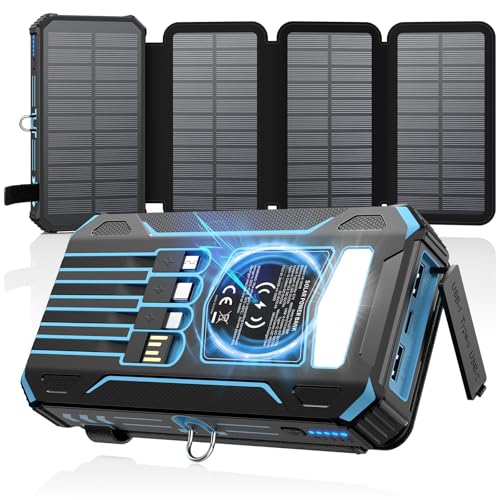
| Battery Capacity | 48000mAh lithium-polymer battery |
| Solar Panel Configuration | 4 high-efficiency solar panels |
| Maximum Solar Charging Speed | Up to 5 times faster than standard single-panel chargers |
| Ports and Cables | 2 USB-A outputs, 1 USB-C input/output, 4 built-in cables (USB-C, Phone, USB-A, Micro), wireless charging pad |
| Wireless Charging Compatibility | Supports all wireless-enabled devices, including iPhone 12/13/14/15/16/17 series and Galaxy S21/S22/S23/S24 series |
| Fast Charging Output | 5V/3A via USB-C port, capable of charging compatible devices from 15% to 60% in 30 minutes |
Unlike most solar power banks I’ve handled, this SOARAISE model immediately catches your eye with its four sleek solar panels, which feel sturdy yet lightweight. You’ll notice right away how much faster it charges outdoors—thanks to those upgraded panels, it can boost power up to five times quicker than typical single-panel chargers.
The massive 48,000mAh capacity means you’re not constantly tethered to outlets, making it perfect for long hikes or camping trips. Its smooth, matte finish makes it comfortable to hold, and the built-in cables are surprisingly versatile.
I especially appreciated the wireless charging pad—just place your phone on it, and it powers up without fuss.
Using it with multiple devices was a breeze. It supports up to 7 gadgets at once, thanks to two USB-A ports, a USB-C port, and four integrated cables, including a Micro and Phone cable.
The USB-C port’s fast-charging feature is legit—my iPhone went from 15% to 60% in just half an hour. Charging in direct sunlight was surprisingly efficient, even with some clouds drifting by.
One thing to keep in mind: while the solar panels are excellent for topping off devices on the go, they’re not designed for quick full recharges without wall power. Still, for outdoor use, I found it reliable and genuinely helpful.
Overall, it’s a solid choice for anyone needing robust, portable, and eco-friendly power.
BLAVOR 20000mAh Solar Power Bank & Wireless Charger
- ✓ Fast charging support
- ✓ Multiple device compatibility
- ✓ Durable and waterproof
- ✕ Solar charging is slow
- ✕ Slightly heavy to carry
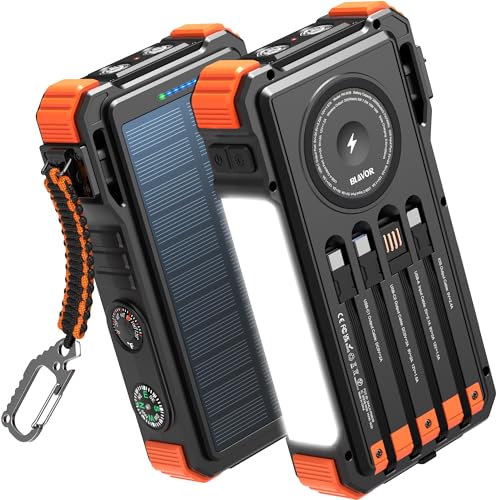
| Battery Capacity | 20,000mAh |
| Fast Charging Output | 20W USB-C port |
| Wireless Charging Compatibility | Qi-enabled devices and Apple Watch |
| Built-in Cables | 2 USB-C, 1 iOS, 1 USB-A |
| Durability Features | Waterproof, shockproof, dustproof with flame-retardant ABS+PC shell |
| Additional Features | Solar panel for outdoor charging, flashlight with 3 modes, camping light with 3 levels, red indicator light, compass, thermometer, carabiner, rope |
Many folks assume that solar power banks are just bulky, slow chargers that only work in perfect sunlight. My experience with the BLAVOR 20000mAh Solar Power Bank completely debunks that myth.
This thing is surprisingly versatile and efficient, even on cloudy days or indoors.
Right out of the box, I noticed its solid build. The flame-retardant ABS+PC shell feels tough, and the waterproof silicone adds a layer of confidence.
It’s hefty but not heavy enough to be a burden for backpacking. The 4 built-in cables and 3 charging ports mean I could power up to six devices simultaneously without hunting for extra adapters.
The wireless charging area is super handy—just place your phone or Apple Watch, and it starts charging. I tested it with my iPhone 15, and the 20W fast charge topped it up in around 50 minutes.
That’s pretty impressive for a solar power bank, especially considering the 20,000mAh capacity. The solar panel itself is a bonus, though I found it works best as a supplementary power source, not the main one.
The accessory features are a game-changer. The flashlight with three modes, the camping light, and the compass turn this into a true outdoor buddy.
Plus, the thermometer and carabiner are thoughtful touches for hikers and adventurers. Safety features like overcharge protection gave me peace of mind during multiple charges.
Overall, this power bank is a rugged, multi-functional device that delivers on its promises. It’s perfect for camping, travel, or emergencies—anywhere you need reliable power with a bit of adventure flair.
BigBlue 28W Solar Panel Charger with Dual USB-C & USB-A

- ✓ Lightweight and portable
- ✓ High efficiency in low light
- ✓ Durable water-resistant design
- ✕ No built-in battery
- ✕ Needs direct sunlight
| Power Output | 28W maximum power with 25.4% sunlight conversion efficiency |
| Ports | Two USB-C ports and one USB-A port, each supporting 5V/3A output |
| Dimensions | 11 x 6 x 1.4 inches when folded |
| Weight | 1.5 lbs (approximately 680 grams) |
| Water Resistance | IP44 waterproof rating (resistant to rain, fog, and wear) |
| Cell Technology | Advanced N-type solar cells with shadow-free surface design for improved low-light efficiency |
You’re sitting on a rocky trail, backpack heavy on your shoulders, with the sun beating down. You pull out your BigBlue 28W solar panel, unfold it, and instantly notice how sleek and lightweight it is—just over a pound but feeling sturdy.
The surface is shadow-free, so you don’t worry about any metal lines blocking sunlight. As you angle it towards the sun, it quickly starts converting rays into power, and that familiar blue glow on the junction box confirms it’s working smoothly.
Connecting your phone and GPS simultaneously is a breeze thanks to the upgraded triple ports. Each USB-C and USB-A delivers fast charging, which is perfect when you’re miles from an outlet.
The panel’s efficiency shines in low-light conditions too—still pulling in some juice as clouds drift overhead.
What really stands out is its durability. The polymer surface resists rain and fog, so you don’t have to panic if a sudden shower hits.
Just keep in mind, it’s meant for direct sunlight—you won’t get much from inside a tent or behind a windshield.
Setting it up is super quick. Just unfold, position towards the sun, and connect your device.
It’s a lifesaver for camping, hiking, or emergency prep, especially since it folds down small enough to fit in your pack without adding bulk.
It doesn’t store power on its own, so you need sunlight and a device connected to get the most out of it. Still, for on-the-go charging when sunlight’s available, this panel delivers solid performance and peace of mind in the outdoors.
What Is a Solar Panel Power Bank and How Does It Work?
A solar panel power bank is a portable battery storage device that utilizes solar panels to convert sunlight into electrical energy, which can then be used to recharge various electronic devices such as smartphones, tablets, and laptops. These power banks are particularly useful for outdoor activities, emergency situations, and areas with limited access to traditional power sources.
According to the U.S. Department of Energy, solar technology harnesses energy from the sun through photovoltaic cells, which convert solar radiation into electricity. This technology has become increasingly popular due to its sustainability and the growing need for renewable energy sources.
Key aspects of solar panel power banks include their capacity, efficiency, and charging speed. Capacity is typically measured in milliamp hours (mAh), indicating how much energy the power bank can store. Higher capacity units can charge devices multiple times before needing a recharge themselves. Efficiency refers to how well the solar panels convert sunlight into usable electricity; most modern solar panels have an efficiency rate between 15% and 22%. Additionally, the charging speed can vary based on the power bank’s output rating, with some models offering quick charge capabilities.
The impact of solar panel power banks is significant, especially for users who are frequently outdoors or in remote locations. They offer a reliable power source that reduces dependency on traditional electricity, which can be particularly valuable during emergencies when regular power grids may fail. Furthermore, by utilizing renewable energy, they contribute to reducing one’s carbon footprint and promoting environmentally friendly practices.
Statistics show that the market for solar power banks is growing rapidly, with a projected compound annual growth rate (CAGR) of 20.5% from 2021 to 2028, reflecting an increasing consumer preference for eco-friendly alternatives. The benefits of these devices extend beyond convenience, as they also support sustainable energy practices and can save money on electricity costs in the long run.
To maximize the benefits of a solar panel power bank, users should consider best practices such as selecting a unit with a higher mAh rating for longer trips, placing the solar panels in direct sunlight for optimal charging, and using devices with low power consumption to extend battery life. Regular maintenance, such as keeping the solar panels clean and ensuring the battery is charged periodically, can also enhance the longevity and effectiveness of the power bank.
What Features Make a Solar Panel Power Bank Ideal for Users?
The ideal solar panel power bank should possess several key features to enhance user experience and efficiency.
- High Efficiency Solar Cells: A solar panel power bank should utilize high-efficiency solar cells, which convert sunlight into electricity more effectively. This ensures that the power bank can charge itself quickly even in less-than-ideal sunlight conditions, maximizing the energy harvested during daylight hours.
- Multiple Charging Ports: An ideal power bank should come with multiple charging ports, allowing users to charge several devices simultaneously. This feature is especially beneficial for those who travel with multiple gadgets, as it saves time and enhances convenience without needing to wait for one device to charge before plugging in another.
- Compact and Lightweight Design: Portability is crucial for a solar panel power bank, so a compact and lightweight design is essential. A power bank that is easy to carry makes it more practical for outdoor activities like hiking or camping, where users may need to rely on portable charging solutions.
- Durability and Weather Resistance: Given that solar power banks are often used outdoors, they should be built to withstand rough conditions. A durable and weather-resistant design protects the device from rain, dust, and shock, ensuring it remains functional even in challenging environments.
- High Battery Capacity: A power bank should have a high battery capacity to store enough energy for multiple charges. This feature is particularly important for users who spend extended periods away from conventional power sources, ensuring that they can keep their devices powered throughout their outdoor adventures.
- Fast Charging Technology: The inclusion of fast charging technology can significantly enhance the user experience by reducing the time it takes to charge devices. This feature allows for quicker power delivery, which is especially useful in urgent situations where users need to rapidly recharge their devices.
- LED Indicator Lights: LED indicator lights are helpful for users to monitor the charging status and battery level of the power bank. These visual indicators provide clear feedback on the amount of stored energy, making it easier to manage power usage during outings.
- Built-in Safety Features: An ideal solar panel power bank should include built-in safety features such as overcharge protection, short circuit protection, and temperature control. These safety measures protect both the power bank and the devices being charged, reducing the risk of damage or accidents.
How Does Battery Capacity Affect Performance?
Power Output: The power output of the bank is critical for users who need quick charging capabilities. A higher output allows for faster charging rates, which is beneficial when charging multiple devices or when time is limited.
Charging Speed: Charging speed is influenced by both the battery capacity and the technology used. Many high-capacity power banks employ fast charging protocols, making them suitable for users who are always on the go and require quick top-ups for their devices.
Longevity and Cycle Life: The relationship between battery capacity and longevity is significant; higher capacity batteries may be designed to handle more charge cycles, thus lasting longer over time. This is particularly important for solar panel power banks, as they are often used in outdoor settings where frequent charging is necessary.
Portability: As battery capacity increases, the weight and size of the power bank often do as well. Users seeking a balance between capacity and portability must consider their specific needs, especially if they plan to carry the power bank for extended periods during outdoor activities.
What Role Does Solar Charging Efficiency Play?
Solar charging efficiency is crucial for maximizing the performance and usability of solar panel power banks.
- Conversion Rate: The conversion rate refers to how effectively the solar panel converts sunlight into usable electrical energy. Higher conversion rates mean that more sunlight can be transformed into power, leading to faster charging times and increased energy output, which is essential for users who rely on their devices during outdoor activities.
- Solar Cell Technology: Different types of solar cell technologies, such as monocrystalline, polycrystalline, and thin-film, exhibit varying efficiencies. Monocrystalline cells are typically the most efficient and compact, making them ideal for portable power banks, whereas polycrystalline cells are less expensive but may take up more space and be slightly less efficient.
- Environmental Conditions: The efficiency of solar charging can be significantly affected by environmental factors such as temperature, shading, and the angle of sunlight. For instance, power banks perform optimally in direct sunlight; any obstruction or poor positioning can reduce their efficiency, leading to slower charging rates.
- Battery Capacity: The battery capacity of a solar power bank influences how much energy it can store from the solar panels. A larger battery capacity requires more energy to charge, so higher solar charging efficiency becomes essential for ensuring that the power bank can fully recharge its battery within a reasonable time frame when relying on solar energy alone.
- Portability and Design: The design and portability of solar panel power banks can impact how efficiently they capture solar energy. Lightweight and foldable designs allow users to easily position the panels for optimal sun exposure, thus enhancing charging efficiency compared to bulkier models that may not be as convenient to use outdoors.
What Are the Advantages of Using a Solar Panel Power Bank?
The advantages of using a solar panel power bank are numerous, especially for those seeking sustainable energy solutions.
- Eco-Friendly Energy Source: Solar panel power banks utilize renewable energy from the sun, which significantly reduces reliance on fossil fuels. This not only lowers carbon emissions but also promotes a more sustainable lifestyle.
- Portability: Most solar panel power banks are designed to be compact and lightweight, making them easy to carry during outdoor activities like camping, hiking, or traveling. Their portability ensures that users can charge devices on the go without the need for traditional power sources.
- Versatility: These power banks often come equipped with multiple charging ports, allowing users to charge various devices simultaneously, such as smartphones, tablets, and GPS devices. This versatility makes them suitable for a wide range of users and situations.
- Self-Sufficiency: With the ability to generate power from sunlight, users can recharge their power banks even in remote locations where conventional power outlets are unavailable. This self-sufficiency is particularly beneficial for outdoor enthusiasts who spend extended periods away from civilization.
- Cost Savings: Although the initial investment may be higher than traditional power banks, solar power banks can save money in the long run by reducing electricity costs. Users can rely on free solar energy for charging instead of paying for electricity from the grid.
- Durability and Weather Resistance: Many solar panel power banks are built to withstand outdoor conditions, featuring rugged designs and weatherproof materials. This durability ensures they can endure various environmental challenges, making them ideal for outdoor use.
What Are the Most Recommended Solar Panel Power Banks on the Market?
The best solar panel power banks available on the market offer reliable charging solutions for outdoor activities and emergencies.
- Anker PowerCore Solar 20000: This power bank combines a large capacity with efficient solar charging capabilities, making it ideal for extended outdoor trips.
- RAVPower 25000mAh Solar Power Bank: Known for its high capacity and multiple output ports, this power bank is perfect for charging multiple devices simultaneously.
- BigBlue 28W Solar Charger: While primarily a solar charger, it often comes with a built-in power bank, offering versatility for outdoor enthusiasts.
- <strong:X-Dragon 20,000mAh Solar Power Bank: This model offers a rugged design and high solar efficiency, suitable for camping or hiking in remote areas.
- <strong:Suaoki 15000mAh Portable Solar Charger: Designed for both portability and durability, this charger is equipped with advanced solar technology for efficient charging.
Anker PowerCore Solar 20000: This power bank features a 20,000mAh capacity that allows for multiple device charges, and its solar panel ensures that you can recharge it while on the go, albeit slowly. It is built with weather-resistant materials, making it a reliable choice for outdoor adventures.
RAVPower 25000mAh Solar Power Bank: With a massive capacity of 25,000mAh, this power bank can charge your smartphone several times and supports quick charging technology. It includes multiple USB ports, allowing you to charge several devices at once, making it perfect for group outings.
BigBlue 28W Solar Charger: This product stands out for its high-efficiency solar panels, which can generate enough power to charge devices directly or to recharge its built-in battery. It is lightweight and portable, making it a great companion for campers, hikers, and travelers who need reliable power.
X-Dragon 20,000mAh Solar Power Bank: This solar power bank features a rugged design that is both waterproof and shockproof, making it ideal for outdoor use. It also offers a high conversion rate for solar charging, ensuring that even in low-light conditions, it can still gather energy effectively.
Suaoki 15000mAh Portable Solar Charger: This model is compact and lightweight, designed for easy transport while still delivering a decent capacity for charging devices multiple times. It also comes equipped with smart charging technology that optimizes the charging speed based on the device connected.
Which Models Stand Out in Terms of User Ratings?
The best solar panel power banks that stand out in terms of user ratings include:
- Anker PowerCore Solar 20000: Highly rated for its robust build and fast charging capabilities.
- <strong:RAVPower 25000mAh Solar Power Bank: Known for its high capacity and multiple output ports, making it versatile for various devices.
- <strong:BigBlue 28W Solar Charger: Praised for its efficiency in solar charging and compact design, ideal for outdoor activities.
- <strong:SOLO 60W Solar Power Bank: Recognized for its powerful output and ability to charge larger devices, including laptops.
Anker PowerCore Solar 20000: This model is favored for its durability and waterproof design, making it suitable for outdoor use. Users appreciate its dual USB output, allowing simultaneous charging of devices, and its ability to retain power efficiently.
<strong:RAVPower 25000mAh Solar Power Bank: With a massive battery capacity, this power bank can charge multiple devices multiple times before needing a recharge itself. Its quick charging technology and three output ports receive high praise from users who need reliable power on the go.
<strong:BigBlue 28W Solar Charger: This power bank excels in solar efficiency, with three USB ports for charging multiple devices simultaneously. Users love its lightweight and foldable design, making it a favorite among hikers and campers who need reliable solar power in remote areas.
<strong:SOLO 60W Solar Power Bank: This model stands out for its ability to deliver high wattage, enabling it to charge larger devices like laptops. Users commend its versatility and the ability to use it in various settings, whether for travel, work, or outdoor adventures.
What Unique Features Do Top-Rated Models Offer?
The best solar panel power banks offer a variety of unique features that enhance their functionality and efficiency.
- High Solar Conversion Efficiency: Many top-rated models use monocrystalline solar cells that provide higher efficiency rates, converting more sunlight into usable power compared to polycrystalline options.
- Multiple USB Ports: These power banks often come equipped with multiple USB ports, allowing users to charge several devices simultaneously, which is particularly useful for group outings or when traveling.
- Built-in Flashlight: A built-in flashlight feature is common in high-quality solar power banks, making them practical for outdoor activities or emergency situations when lighting is needed.
- Durability and Weather Resistance: Top models are typically designed to be rugged, with water-resistant and shockproof features that ensure they can withstand outdoor conditions and rough handling.
- Fast Charging Technology: Many of the best solar panel power banks include fast charging capabilities, which allow devices to charge more quickly, reducing downtime when power is needed urgently.
- Battery Capacity: Higher capacity batteries (measured in mAh) are a hallmark of premium models, enabling them to store more energy and provide prolonged charging for multiple devices over extended periods.
- Compact and Lightweight Design: The best models prioritize portability, offering a lightweight and compact design that makes them easy to carry on hikes or camping trips without adding much burden.
- LED Power Indicator: An LED display or indicator lights show the remaining battery life and solar charging status, allowing users to monitor power levels and plan device usage accordingly.
What Are Common Limitations of Solar Panel Power Banks?
Common limitations of solar panel power banks include:
- Efficiency in Low Light Conditions: Solar panel power banks often struggle to generate adequate energy on cloudy or rainy days, significantly limiting their charging capabilities.
- Charging Speed: The rate at which solar power banks charge devices can be slower compared to traditional power banks, especially when relying solely on solar energy.
- Size and Portability: Some solar panel power banks can be bulky or heavy due to the size of the solar panels, making them less convenient for travel compared to more compact alternatives.
- Cost: Solar panel power banks tend to be more expensive than standard power banks due to the added solar technology, which may not justify the investment for casual users.
- Battery Capacity and Lifespan: Many solar power banks feature smaller battery capacities, which can limit the number of devices that can be charged, and the lifespan of the batteries can be shorter with frequent solar charging.
Efficiency in low light conditions is a significant drawback for solar panel power banks, as they require direct sunlight to operate effectively. In situations where light is minimal, these power banks may not provide enough energy, leading to frustrations for users relying on them for outdoor activities.
The charging speed of solar power banks is generally slower than that of traditional power banks, particularly when using solar energy alone. While they can charge devices in sunlight, the time taken to reach a full charge can be impractical for users who need their devices charged quickly.
Size and portability can be a concern with solar panel power banks; larger solar panels often lead to bulkier designs. This can make them less appealing for those seeking a lightweight and easily transportable option, especially for hiking or backpacking.
The cost of solar panel power banks is another limitation, as they are often priced higher than standard models due to the inclusion of solar technology. For users who do not frequently utilize solar charging, this added expense may not be worthwhile.
Battery capacity and lifespan are crucial factors; many solar power banks have smaller batteries, which can limit how many devices can be charged before needing to recharge the bank itself. Furthermore, the frequent cycle of charging via solar energy can lead to shorter battery life compared to conventional power banks, diminishing their long-term value.
How Can You Ensure the Longevity of Your Solar Panel Power Bank?
To ensure the longevity of your solar panel power bank, consider the following best practices:
-
Proper Storage: When not in use, store the power bank in a cool, dry place away from direct sunlight. Extreme temperatures can degrade battery performance.
-
Regular Charging: Keep the solar power bank partially charged. Lithium-ion batteries perform best when they are maintained between 20-80% charge.
-
Avoid Over-discharge: Discharging the power bank completely can shorten its lifespan. Recharge it when it hits around 20% capacity to prevent deep discharge.
-
Gentle Handling: Protect the device from physical impacts. Dropping or hitting the power bank can damage internal components and reduce its efficiency.
-
Clean Solar Panels: Keep the solar panels clean from dirt, dust, and debris, as this can block sunlight and reduce charging efficiency. Use a soft cloth to wipe them down periodically.
-
Use Compatible Devices: Only connect devices that are compatible with the power bank’s output voltage to avoid damaging the battery.
Implementing these practices will help extend the life of your solar panel power bank, ensuring reliable performance during outdoor adventures or emergency situations.
Related Post: