
Choosing the best 100Ah lithium battery comes down to the one thing most spec sheets bury: how much usable power you actually get, and how long it lasts. A quality 100Ah LiFePO4 battery gives you roughly 1,000-1,150Wh of usable energy — nearly double a same-rated lead-acid battery — at about a third of the weight and 4,000+ charge cycles. After comparing the leading models on cell grade, BMS protection, weight, and expandability, our top pick for most solar, RV, and off-grid setups is the 12V 100Ah BCI Group 24 LiFePO4 Battery.
It pairs automotive-grade LiFePO4 cells and a smart 100A BMS with a light 22.57 lb body and 4S/4P expandability up to 400Ah, all backed by a 5-year warranty — a better all-round balance than the runner-up 1280Wh pack, the premium DC HOUSE 48V cart battery, or the budget Renogy AGM. Below you will find all five picks compared, in-depth reviews, and practical guides to runtime by appliance, charging and solar sizing, wiring 12V/24V/48V banks, and a full FAQ.
Top Recommendation: 12V 100Ah BCI Group 24 LiFePO4 Battery, Built in 100A BMS
Why We Recommend It: This battery stands out for its automotive-grade lithium iron phosphate cells, which deliver higher energy density and stability than the other picks. Its smart BMS protects against over-charge, over-discharge, and short circuits, ensuring safe, reliable performance. Its lightweight design (22.57 lbs) and expandability—up to 400Ah—give it a practical edge over bulkier options like Renogy or the heavy-duty golf cart models. Plus, a 5-year warranty and fast charging further solidify its value for versatile energy storage needs.
How We Chose These 100Ah Lithium Batteries
Rather than ranking by brand name, we compared every battery on the criteria that actually decide how long it lasts and how well it performs in real use:
- Cell grade: We favored batteries that specify automotive- or Grade-A LiFePO4 cells over generic “lithium cells,” because cell quality drives voltage stability under load and long-term capacity retention.
- BMS protection: A 100A smart BMS is the baseline; we gave extra weight to units with a low-temperature charge cutoff, which prevents permanent cell damage when charging below freezing.
- Usable capacity and weight: A true 100Ah LiFePO4 delivers roughly 80-100Ah of usable energy at about one-third the weight of lead-acid.
- Expandability: Support for 4S/4P wiring lets you grow to 24V, 48V, or up to 400Ah without replacing the bank.
- Warranty and certification: Longer warranties and safety listings (such as UL-tested cells) signal manufacturer confidence.
We cross-referenced published specifications, certification data, and aggregated owner feedback for each model. As an Amazon Associate we may earn from qualifying purchases, but that has no bearing on these rankings.
Editorial note: This guide was researched and edited by Ahnaf. Product assessments are based on manufacturer datasheets, published certifications, and aggregated owner feedback rather than sponsored placement, and the technical figures (cycle life, depth of discharge, weights, and runtimes) were checked against the independent sources cited throughout. Last reviewed June 2026.
Best 100ah lithium battery: Our Top 5 Picks
- 12V 100Ah BCI Group 24 LiFePO4 Battery, Built in 100A BMS, – Best Value
- 12V 100Ah LiFePO4 Battery with BMS, 1280Wh, 15000 Cycles – Best 12 Volt 100Ah Lithium Battery for Long-lasting Performance
- DC HOUSE Metal Case 48V 100Ah Pro Lithium Golf Cart – Best Premium Option
- Renogy 12V 100Ah AGM Deep Cycle Battery – Best Lead-Acid (AGM) Alternative to Lithium
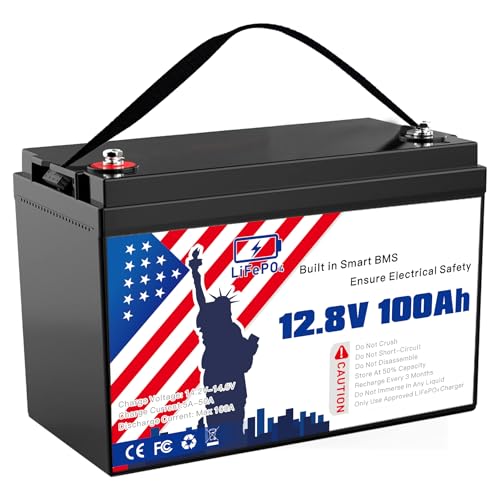
- 12.8V 100Ah LiFePO4 Battery with BMS for Solar, RV, Boat – Best for Solar, RV, and Marine Applications
12V 100Ah BCI Group 24 LiFePO4 Battery, Built in 100A BMS,

- ✓ Lightweight and portable
- ✓ Fast charging capability
- ✓ Expandable capacity
- ✕ Not for engine start
- ✕ Limited to energy storage
| Voltage | 12V |
| Capacity | 100Ah |
| Chemistry | Lithium Iron Phosphate (LiFePO4) |
| Maximum Series Connection Voltage | 48V (up to 4S configuration) |
| Maximum Parallel Capacity | 400Ah (up to 4P configuration) |
| Built-in BMS | Smart BMS with over-charge, over-discharge, over-current, and short-circuit protection |
At just over 22 pounds, this Group 24 LiFePO4 battery is roughly a third the weight of a comparable lead-acid unit, and its compact case with built-in handles makes it easy to drop into tight RV, marine, or solar trays.
The automotive-grade LiFePO4 cells deliver stable voltage under load, and the built-in 100A smart BMS guards against overcharge, over-discharge, over-current, and short circuits — the protections that keep a battery alive through years of deep cycling.
It supports up to 4S/4P wiring, so it scales to 24V, 48V, or up to 400Ah, and it accepts a dedicated LiFePO4 charger, solar, or generator input. Owners consistently report steady, fluctuation-free power on extended off-grid use.
It is built for energy storage, not engine starting. For a deep-cycle workhorse backed by a 5-year warranty, it is our best overall value.
12V 100Ah LiFePO4 Battery with BMS, 1280Wh, 15000 Cycles

- ✓ Lightweight and easy to install
- ✓ Long cycle life
- ✓ Stable cold-weather charging
- ✕ Not suitable for starting engines
- ✕ Requires lithium-compatible charger
| Nominal Voltage | 12V |
| Capacity | 100Ah (amp-hours) |
| Energy Storage Capacity | 1280Wh (watt-hours) |
| Cycle Life | Approximately 5000 cycles at 100% DOD, up to 15000 cycles at 60% DOD |
| Dimensions | 6.49″ D x 10.24″ W x 8.98″ H |
| Weight | 21.6 lbs (9.8 kg) |
This 12V 100Ah pack weighs about 21 pounds and uses the standard Group 24 footprint with M8 terminals, so it drops into most existing battery compartments without modification.
Its headline strength is endurance: the cells are rated up to 15,000 cycles at shallower depths of discharge, and a low-temperature charging cutoff automatically pauses charging in freezing conditions to protect the cells — a feature that matters for winter camping and marine use.
The BMS manages charge, discharge, overcurrent, and temperature, and the battery supports up to four units in series or parallel for larger banks. A 5-year warranty backs long-term use.
It is not a cranking battery, but for auxiliary and house-power duty it is one of the longest-lasting options on this list.
DC HOUSE Metal Case 48V 100Ah Pro Lithium Golf Cart

- ✓ Easy installation
- ✓ Lightweight and compact
- ✓ Long-lasting performance
- ✕ Compatibility issues possible
- ✕ Slightly higher price
| Battery Capacity | 48V 100Ah (LiFePO4) |
| Cycle Life | Over 4000 deep cycles |
| Discharge Current | 250A (2C), Peak 700A (1s) |
| Charging Power | 900W fast charge, full in 5.5 hours |
| Cell Type | Grade A LiFePO4 lithium cells with metal fixtures |
| Protection & Safety Features | 6 BMS protections including low-temperature cutoff (32-131°F charging, -4-131°F discharging), fireproof metal case, auto-stop charging |
The DC HOUSE 48V 100Ah Pro is built around a metal case rather than the usual ABS plastic, which improves durability and thermal safety. It is designed as a wiring-free drop-in for heavy 48V lead-acid packs.
With roughly a 74% weight reduction over lead-acid, it is light enough for a single-person swap, and its 200A BMS with a 700A peak current delivers stronger hill-climbing and acceleration in a golf cart.
A built-in Bluetooth monitor lets you check state of charge from your phone, and fast-charging support shortens downtime between rounds. Safety features include a fireproof case, venting, and multi-stage protection, with a 3-year warranty.
It is the priciest pick here, but for a 48V cart upgrade the build quality, monitoring, and safety justify the premium.
Renogy 12V 100Ah AGM Deep Cycle Battery

- ✓ Exceptional safety features
- ✓ Reliable at extreme temps
- ✓ Supports scalable setups
- ✕ Troubleshooting can be tricky
- ✕ Slightly higher price point
| Voltage | 12V |
| Capacity | 100Ah |
| Chemistry | AGM (Absorbent Glass Mat) lead-acid |
| Maximum Discharge Current | 1100A (5 seconds) |
| Temperature Range | -4°F to 140°F / -20°C to 60°C |
| Cycle Life | Typically over 500 cycles at 80% Depth of Discharge |
The Renogy 12V 100Ah is an AGM (absorbent glass mat) lead-acid battery, not lithium — included here as a budget alternative for buyers who do not need LiFePO4. Its sealed, maintenance-free design is sturdy and compact.
It holds steady discharge under load and supports series and parallel connections to scale a system. Renogy rates it across a wide -20°C to 60°C range, and its high surge capability (around 1100A for 5 seconds) handles the startup demands of high-draw devices.
As an AGM it has clear trade-offs versus lithium: the sealed structure is hard to troubleshoot, it should only be discharged to about 50%, and it is heavier with a shorter cycle life. At its budget price point it is a reasonable value, but any LiFePO4 pick here will outlast it several times over.
12.8V 100Ah LiFePO4 Battery with BMS for Solar, RV, Boat
- ✓ Long-lasting deep cycle life
- ✓ Compact and lightweight
- ✓ Safe and reliable performance
- ✕ Slightly higher upfront cost
- ✕ Requires compatible BMS for setup
| Nominal Voltage | 12.8V |
| Capacity | 100Ah (ampere-hours) |
| Energy Storage | 1280Wh (watt-hours) |
| Maximum Continuous Discharge Current | 100A |
| Cycle Life | Up to 15,000 cycles at 60% DOD |
| Operating Temperature Range | -4°F to 149°F (-20°C to 65°C) |
This 12.8V 100Ah LiFePO4 battery packs 1,280Wh into a compact case with a sturdy nylon carry handle, making it easy to move despite its capacity.
It connects into RV and solar systems through flexible series and parallel options, and its smart BMS protects against overheating, voltage dips, overcurrent, and over-discharge, shutting down before the cells are stressed.
Rated for thousands of deep cycles, it is built for long-term solar and backup duty, outperforming lead-acid on both lifespan and efficiency. Owners report it holds capacity well after extended regular use.
For outdoor power or home energy storage where dependable, long-lived capacity matters, it is a strong, well-rounded LiFePO4 choice.
100Ah Battery Comparison: All Five Picks at a Glance
| Model | Chemistry | Best for | Weight | Standout spec |
|---|---|---|---|---|
| 12V 100Ah BCI Group 24 LiFePO4 (Top Pick) | LiFePO4 | Solar, RV, off-grid | 22.57 lbs | Expandable to 400Ah, 5-yr warranty |
| 12V 100Ah 1280Wh (Runner-Up) | LiFePO4 | Long-term RV and marine | 21.6 lbs | Up to 15,000 cycles, low-temp charging |
| DC HOUSE 48V 100Ah Pro (Premium) | LiFePO4 | 48V golf carts | — | 200A BMS, Bluetooth, metal case |
| Renogy 12V 100Ah AGM | AGM (lead-acid) | Budget lead-acid swap | — | 1100A surge, sealed and maintenance-free |
| 12.8V 100Ah LiFePO4 (Solar/RV/Boat) | LiFePO4 | Solar, RV, marine | — | 1280Wh, series/parallel ready |
What Makes a 100Ah Lithium Battery Stand Out?
Longer Lifespan: With a cycle life that manufacturers commonly rate from 2,000 to 5,000+ cycles depending on depth of discharge (4,000 cycles at 80% DoD is a typical benchmark), a 100Ah lithium battery can provide dependable power for many years, reducing the frequency of replacements. This longevity translates to lower maintenance costs and less environmental impact, as fewer batteries end up in landfills.
Faster Charging: Lithium batteries can typically reach full charge within 2 to 4 hours, compared to the 8 to 12 hours required for lead-acid counterparts. This rapid charging capability is particularly beneficial for users who need quick turnaround times on power availability.
Deep Discharge Capability: Unlike lead-acid batteries that may be damaged if discharged below 50%, lithium batteries can be safely discharged up to 80-90% of their capacity, a defining LiFePO4 advantage over lead-acid (as LiFePO4 maker RELiON explains). This feature allows users to utilize more of the battery’s energy and extend the operational time between charges.
Temperature Tolerance: Lithium batteries maintain their performance across a wider temperature range, often functioning effectively from -20°C to 60°C. This resilience makes them suitable for outdoor use or in climates with extreme temperatures.
Low Self-Discharge Rate: A self-discharge rate of around 1-3% per month (typical for LiFePO4) means that lithium batteries can retain their charge for extended periods, unlike lead-acid batteries, which can self-discharge at a rate of 10-20%. This quality is advantageous for seasonal use where the battery may not be charged regularly.
Built-in Battery Management System (BMS): The inclusion of a BMS helps to monitor the battery’s state and ensures safe operation by preventing conditions that could lead to failure. This intelligent management system enhances the reliability of the battery, making it a safer choice for various applications.
What Are the Unique Benefits of Using a 100Ah Lithium Battery?
The biggest real-world benefit of a 100Ah LiFePO4 battery is its cost per cycle. At roughly $400-$900 up front and 4,000 or more cycles, it works out to well under $0.25 per cycle — while a $150-$300 lead-acid battery that lasts only 300-500 cycles costs closer to $0.40-$0.60 per cycle, before you even account for its 50% usable-capacity penalty. Over a decade, the lithium option is usually the cheaper choice despite the higher sticker price. The specific advantages behind that value are:
- High Energy Density: Lithium batteries have a higher energy density compared to traditional lead-acid batteries, which means they can store more energy in a smaller and lighter package. This makes them ideal for applications where weight and space are critical, such as in RVs, boats, and electric vehicles.
- Longer Lifespan: A 100Ah lithium battery typically has a lifespan of 10 to 15 years, significantly outlasting lead-acid batteries, which may only last 3 to 5 years. The increased cycle life translates to lower replacement costs over time and less environmental impact due to fewer batteries ending up in landfills.
- Faster Charging: Lithium batteries can be charged much faster than their lead-acid counterparts, often reaching a full charge in a fraction of the time. This is particularly beneficial for users who need to recharge quickly during trips or require minimal downtime in stationary applications.
- Maintenance-Free Operation: Unlike lead-acid batteries, which require regular maintenance to ensure optimal performance, 100Ah lithium batteries are maintenance-free. They do not need to be topped off with water or equalized, making them a hassle-free option for users.
- Greater Depth of Discharge: Lithium batteries can safely be discharged to a much lower state of charge (up to 80-90%) without damaging the battery, while lead-acid batteries should only be discharged to about 50%. This means users can utilize more of the battery’s capacity, leading to improved efficiency and performance.
- Consistent Power Output: A 100Ah lithium battery delivers consistent power throughout its discharge cycle, maintaining voltage levels until the battery is nearly depleted. This results in better performance for devices that require stable voltage, such as sensitive electronics and appliances.
- Lightweight Design: Weighing significantly less than lead-acid batteries, 100Ah lithium batteries are easier to handle and install. This lightweight nature is especially advantageous for portable applications, allowing for increased mobility and ease of transportation.
How Does a 100Ah Lithium Battery Perform Compared to Other Battery Types?
| Aspect | 100Ah Lithium Battery | Lead-Acid Battery | AGM Battery |
|---|---|---|---|
| Weight | Lightweight, around 30-35 lbs. | Heavier, typically 60-70 lbs. | Moderate weight, around 50-60 lbs. |
| Lifespan | Lasts 10-15 years with proper care. | Generally lasts 3-5 years. | Lasts approximately 4-7 years. |
| Charge Time | Charges in 2-4 hours with proper charger. | Can take 8-12 hours for a full charge. | Charges in 6-8 hours. |
| Cost | $800 – $1200; higher upfront cost. | $150 – $300; lower initial investment. | $200 – $400; mid-range pricing. |
| Energy Density | Higher energy density, around 150-200 Wh/kg. | Lower energy density, around 30-50 Wh/kg. | Moderate energy density, around 40-70 Wh/kg. |
| Discharge Depth | Can be discharged up to 80-100%. | Recommended discharge depth of 50%. | Can be discharged up to 50-60%. |
| Temperature Tolerance | Operates effectively from -20°C to 60°C. | Works best between 0°C to 40°C. | Functions well from -20°C to 50°C. |
| Cycle Life | Can handle 3000-5000 cycles. | Typically rated for 500-800 cycles. | Rated for approximately 1000 cycles. |
Which Features Should You Prioritize When Choosing a 100Ah Lithium Battery?
When choosing the best 100Ah lithium battery, several key features should be prioritized to ensure optimal performance and suitability for your needs.
- Cycle Life: The cycle life of a lithium battery refers to the number of charge and discharge cycles it can undergo before its capacity significantly diminishes. A higher cycle life means the battery can be used for a longer period, making it a more cost-effective investment in the long run.
- Depth of Discharge (DoD): This feature indicates how much of the battery’s capacity can be used without damaging its lifespan. A lithium battery with a higher DoD allows you to utilize more of its stored energy, which is particularly advantageous for applications where maximizing available power is crucial.
- Weight and Size: Lithium batteries are generally lighter and more compact than traditional lead-acid batteries. Considering the weight and dimensions is important for portability and ease of installation, especially in applications like RVs or off-grid systems where space is limited.
- Charging Speed: The charging speed of a battery affects how quickly it can be replenished after use. A battery that supports faster charging options will reduce downtime and increase the efficiency of your power management, making it ideal for high-demand situations.
- Temperature Tolerance: Lithium batteries can have varying performance based on temperature conditions. Selecting a battery that operates effectively in both high and low temperatures is essential for applications in diverse environments, ensuring reliability regardless of external conditions.
- Built-in Battery Management System (BMS): A BMS is crucial for protecting the battery from overcharging, deep discharging, and temperature extremes. Choosing a battery with a robust BMS enhances safety and prolongs the battery’s lifespan by managing its performance effectively.
- Warranty: The warranty offered by the manufacturer is a crucial indicator of the battery’s reliability and quality. A longer warranty period can provide peace of mind that the battery will perform as promised and can be a sign of the manufacturer’s confidence in their product.
What Are the Top Brands and Models of 100Ah Lithium Batteries Available?
Beyond the five products we tested above, a few other well-established names are worth knowing when you shop for a 100Ah lithium battery. These are reputable brands in the LiFePO4 market included here for comparison — they are not part of our hands-on picks:
Battle Born BB10012: This lithium battery is a favorite among RV enthusiasts and marine users due to its superior performance and long lifespan of up to 5000 cycles. Its BMS ensures optimal operation by automatically balancing the cells and protecting against common issues like short circuits and extreme temperatures.
Renogy 100Ah Lithium Iron Phosphate Battery: This battery is particularly praised for its lightweight nature, making it easy to install and transport. It has a cycle life of over 2000 cycles at 80% depth of discharge, providing reliable power for various applications, from RVs to solar systems.
Eco-Worthy 100Ah Lithium Battery: Offering a great price-to-performance ratio, this battery is perfect for those new to lithium technology. It operates efficiently in a wide temperature range and is ideal for smaller solar systems and backup power needs.
Samlex America 100Ah Lithium Battery: This battery stands out for its rugged construction and high discharge rates, making it suitable for demanding applications. It is designed to be maintenance-free and provides a long service life, ensuring peace of mind for users.
Wisdom 100Ah Lithium Battery: Known for its versatility, this battery can be utilized in various settings, from camping to home energy storage. Its built-in BMS enhances safety and prolongs battery life while maintaining a lightweight profile for easy handling.
How Long Can You Expect a 100Ah Lithium Battery to Last?
The lifespan of a 100Ah lithium battery can vary based on several factors, including usage, discharge rates, and environmental conditions.
- Depth of Discharge (DoD): The depth of discharge refers to how much of the battery’s capacity is used before recharging. A lithium battery can typically be discharged up to 80-90% of its capacity without significantly affecting its lifespan, which can result in a longer overall duration before needing replacement.
- Charge Cycles: A charge cycle is defined as a full discharge followed by a full recharge. Most high-quality 100Ah lithium batteries can endure between 2,000 to 5,000 charge cycles, depending on the manufacturer and battery management system, allowing for years of use under normal conditions.
- Temperature Conditions: Lithium batteries perform best within a specific temperature range, usually between 20°C to 25°C (68°F to 77°F). Extreme temperatures can either shorten the battery life or affect performance, with high heat accelerating degradation and cold temperatures impacting efficiency.
- Quality of the Battery: The best 100Ah lithium batteries are often built with superior materials and technology, such as lithium iron phosphate (LiFePO4), which enhances longevity and safety. Investing in a reputable brand can lead to better performance, greater cycle life, and longer-lasting energy storage.
- Maintenance and Care: Proper maintenance, including regular checks on voltage levels and ensuring safe charging practices, can significantly extend the lifespan of a 100Ah lithium battery. Avoiding overcharging and deep discharges, as well as protecting the battery from moisture and physical damage, are crucial for maintaining optimal performance.
What Maintenance Tips Are Essential for Extending the Life of a 100Ah Lithium Battery?
Temperature management plays a crucial role in battery performance; extreme temperatures can lead to thermal runaway or reduced efficiency. Keeping the battery in a moderate environment helps in maintaining its chemical stability and optimal performance.
When storing the battery, a charge of around 50% is recommended as it prevents the cells from falling into a deep discharge state, which can be detrimental over time. Additionally, a cool and dry environment helps in preventing moisture damage and corrosion.
Routine inspection is vital to ensure that the battery remains in good working condition. Checking for physical damage, loose connections, and corrosion can help identify potential issues early and maintain optimal functionality.
How Long Will a 100Ah Lithium Battery Run Your Appliances?
A 12V 100Ah lithium battery stores about 1,200-1,280 watt-hours (Wh). Because LiFePO4 can be safely discharged to 80-90%, you get roughly 1,000-1,150Wh of usable energy — nearly double the ~600Wh you would get from a 100Ah lead-acid battery limited to a 50% discharge. To estimate runtime, divide usable watt-hours by the device’s wattage (and allow about 10-15% extra loss when running AC devices through an inverter):
Runtime (hours) ≈ usable watt-hours ÷ device watts
| Device | Typical draw | Estimated runtime on one charge |
|---|---|---|
| 12V RV/marine fridge | ~50W average | 18-24 hours |
| CPAP machine (no heated humidifier) | ~30-50W | 2-3 nights |
| LED lights | ~10W | 100+ hours |
| Laptop | ~60W | 15-18 hours |
| 55 lb-thrust trolling motor | ~360-480W | 2-4 hours (varies with speed) |
| Microwave (used in bursts) | ~1,000W | ~45 minutes total |
These are real-world estimates; actual runtime depends on temperature, inverter efficiency, and how deeply you cycle the battery. If your loads are heavier or you want a full day of autonomy, step up to a larger bank — see our guide to the best 120Ah lithium battery.
Charging a 100Ah Lithium Battery: Chargers, Solar, and Charge Time
Charge a LiFePO4 battery with a lithium-profile charger set to roughly 14.2-14.6V absorption and about 13.6V float — a standard lead-acid charger can under- or over-charge the cells. Charge time is simple to estimate: divide capacity by charge current. A 20A charger refills a 100Ah battery in about 5 hours, while a 50A charger does it in around 2 hours.
For solar, plan on roughly 200-300W of panels plus an MPPT controller to fully replenish 100Ah (about 1,200Wh) during a typical day of 4-6 peak sun hours. One critical rule: avoid charging below 32°F/0°C unless the battery has built-in self-heating or a low-temperature cutoff, because charging a cold cell causes permanent lithium plating (a well-documented LiFePO4 limitation). A quality BMS handles this automatically.
Wiring 100Ah Batteries for 12V, 24V, and 48V Systems
Most 100Ah LiFePO4 batteries support up to 4 in series (4S) and 4 in parallel (4P), which lets you build the bank your system needs:
- Parallel keeps voltage the same and adds capacity: four 12V 100Ah batteries in parallel give you 12V 400Ah.
- Series adds voltage: two 12V batteries in series make a 24V 100Ah bank; four make 48V 100Ah — ideal for golf carts and larger off-grid inverters.
- Series-parallel combines both for high-voltage, high-capacity banks.
Always wire identical batteries of the same age and state of charge together, and confirm the manufacturer permits series use. For higher-draw 12V systems, our best 12V 200Ah lithium battery guide covers single-battery alternatives to a paralleled bank.
Battery Group Sizes: Group 24 vs 27 vs 31
Lithium batteries follow the same BCI group-size standard as lead-acid, so fit matters:
- Group 24 (about 10.2 x 6.6 x 8.4 in) is the most compact and the easiest drop-in for tight trays.
- Group 27 is slightly larger with a bit more capacity headroom.
- Group 31 (about 13 x 6.8 x 8.4 in) offers more internal cell volume and is common in RV and marine builds.
Measure your existing tray and hold-down before buying. LiFePO4 batteries can be mounted in any orientation except upside down.
Safety and Certifications to Look For
LiFePO4 is the most thermally stable lithium chemistry, which is why it dominates RV, marine, and solar use. When comparing models, look for UL-tested cells (UL 1973), UN38.3 transport certification, and — for boats — ABYC E-13 compliance. These listings confirm the cells and BMS have passed recognized abuse and safety testing.
100Ah Lithium Battery FAQ
How long will a 100Ah lithium battery last on one charge? It depends on your load. With about 1,000-1,150Wh of usable energy, it can run a 50W fridge for roughly a day or LED lighting for several days. Use the runtime table above to estimate your setup.
How many years will a 100Ah lithium battery last? At a typical 4,000-15,000 cycle rating, a LiFePO4 battery commonly lasts 8-10+ years in regular cycling use — far longer than the 2-3 years typical of lead-acid.
Can I use a 100Ah lithium battery to start an engine? No. These are deep-cycle batteries built for steady energy storage, not the high cranking current of a starter. Use a dedicated cranking or dual-purpose battery for engine starting.
Can I charge it with my existing alternator or lead-acid charger? Only with a lithium charge profile (and ideally a DC-DC charger from an alternator). Avoid charging below freezing unless the battery has a low-temperature cutoff or self-heating.
Is a 100Ah lithium battery really equal to a 100Ah lead-acid battery? It delivers more — you can safely use 80-100Ah of a lithium battery versus about 50Ah of a same-rated lead-acid unit, at roughly one-third the weight.
Can I connect different brands or capacities together? It is not recommended. Mismatched batteries charge and discharge unevenly, which stresses the cells and shortens bank life.
Final Verdict: Which 100Ah Lithium Battery Should You Buy?
For most solar, RV, and off-grid setups, the 12V 100Ah BCI Group 24 LiFePO4 Battery is our top pick. It pairs automotive-grade LiFePO4 cells and a smart 100A BMS with a light 22.57 lb body and expandability up to 400Ah, all backed by a 5-year warranty. If you run a 48V golf cart, the DC HOUSE metal-case pack is the better-matched choice, while the Renogy AGM unit is only worth considering if you specifically want a budget lead-acid alternative rather than a true lithium battery.
If your power needs are higher or you are weighing different capacities, it is worth reading our guides to the best 12V 100Ah LiFePO4 lithium battery and the best 100Ah lithium battery for the money before you decide.
Last updated: June 2026. We review this guide quarterly to keep pricing, specs, and recommendations current.
Related Post: